
You’ve got patients in the chair, a treatment plan to discuss, and a waiting room full of people who can see straight through your glass partition. That’s not just awkward, it’s a smart glass dental optometry office San Jose patient privacy problem that any practice with glass walls needs to solve. Smart glass and smart film address it by switching between clear and opaque in under a second, meeting patient privacy expectations without permanent frosting or clunky blinds. In San Jose, where many practices operate in multi-tenant medical office buildings along Hamilton Avenue or in retrofitted retail space near Santana Row, the tenant improvement process and permit rules shape which product makes sense and what it costs. This guide walks through pricing, HIPAA compliance, permit requirements with San Jose’s Building Division, and how to pick the right installer for your buildout.
Get a free estimate from a licensed San Jose smart glass installer before you finalize your tenant improvement drawings, so your electrician and contractor can coordinate wiring and rough openings from day one.
What Does Smart Glass Cost for a San Jose Dental or Optometry Office?
Smart glass for a San Jose dental or optometry office costs $45–$95 per square foot installed, while smart film retrofits on existing glass run $25–$45 per square foot. The spread depends on whether you’re building new partitions or upgrading glass that’s already in place, plus how many switches, sensors, or app controls you want tied into the system.
A typical treatment room door with a sidelite panel, roughly 24 square feet of glass, lands around $1,800–$3,200 for smart film or $3,500–$6,800 for factory-built smart glass with integrated PDLC layers. Consult rooms with larger glass walls, common in optometry practices where the exam lane faces a hallway, can run $8,000–$14,000 for a full switchable partition.
| Application | Product | Typical Cost | Switch Time |
|---|---|---|---|
| Treatment room door + sidelite (24 sq ft) | Smart Film retrofit | $1,800–$3,200 | Under 1 second |
| Treatment room door + sidelite (24 sq ft) | Smart Glass unit | $3,500–$6,800 | Under 1 second |
| Consult room glass wall (60+ sq ft) | Smart Glass system | $8,000–$14,000 | Under 1 second |
| Front desk privacy partition | Smart Film retrofit | $2,200–$4,000 | Under 1 second |
A dental practice in the Willow Glen neighborhood recently retrofitted three treatment room sidelites with smart film for $7,400 total, avoiding a full glass replacement because their existing tempered glass was already up to code. That’s usually the biggest cost lever: if your glass is already tempered and properly sized, film retrofits save thousands over new switchable glass units.
How Does Switchable Glass Satisfy HIPAA Visual Privacy Standards?
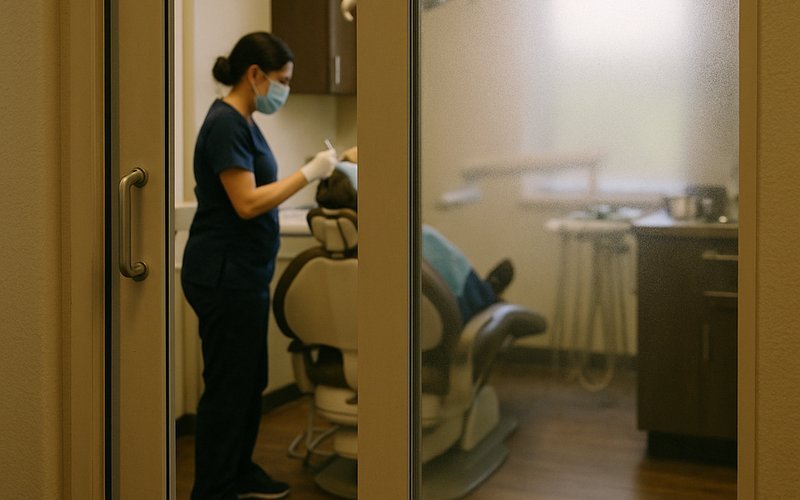
Switchable glass satisfies HIPAA’s visual privacy expectations by giving staff instant, reliable control over sightlines into treatment areas, which is exactly what the HIPAA Privacy Rule requires for protecting patient information from incidental disclosure. HIPAA doesn’t mandate a specific material or product. It requires “reasonable safeguards” against unauthorized viewing of patients or their records, and a glass partition that switches to opaque the moment a patient sits down clears that bar cleanly.
The advantage over blinds or curtains is consistency. Blinds get left open by a rushed hygienist, curtains get pushed aside and never rehung correctly, and both need physical maintenance that adds up over years of daily use in a busy practice. Smart glass removes the human error factor: a switch, a sensor, or a scheduled control panel setting handles it the same way every time.
For optometry practices, this matters even more in phoropter and exam lane areas, where patients often remove glasses or contacts and want assurance that hallway traffic can’t see in. A San Jose optometrist near the Berryessa area installed smart glass sidelites on two exam lanes specifically to address patient complaints about visibility from the reception hallway, a fix that took less than a day per room. This same engineering logic scales up in larger healthcare settings. For a deeper look at how switchable glass systems get specified and installed across full medical facilities, the guide to engineering switchable glass for healthcare facilities covers the technical side in more detail.
Smart Film vs. Frosted Window Film: Which Is Better for a San Jose Waiting Room?
Smart film beats frosted window film for San Jose dental and optometry waiting rooms because it toggles between clear and private, while frosted film is permanently opaque and can’t adapt to changing needs throughout the day. Frosted film costs less upfront, around $8–$15 per square foot, but it locks you into one look and one privacy level, all day, every day.
Smart film costs more, at $25–$45 per square foot, but it lets a front desk switch to clear during slow hours to keep the space feeling open, then flip to opaque the moment a patient is checking in and discussing insurance details or a treatment plan. That flexibility matters most in front desk areas and consult rooms where you want natural light most of the day but full privacy during sensitive conversations.
| Factor | Frosted Window Film | Smart Film |
|---|---|---|
| Cost per sq ft | $8–$15 | $25–$45 |
| Privacy control | Fixed, always opaque | Adjustable, on-demand |
| Natural light | Reduced permanently | Full light when clear |
| Lifespan | 5–8 years | 10–15 years |
| Best for | Fixed privacy zones (bathrooms, storage) | Waiting rooms, consult rooms, treatment doors |
Honestly, frosted film is the right call for areas that only ever need one privacy setting, like a supply closet window or a bathroom sidelite. But for a waiting room in a practice near downtown San Jose, where the space doubles as a reception and consult zone throughout the day, smart film’s flexibility usually pays for itself within a few years through better patient experience and fewer complaints about visibility.
Does San Jose Require a Permit for Smart Glass in a Medical Office Tenant Improvement?
Yes, San Jose requires a building permit for smart glass installation when it’s part of a medical office tenant improvement, because the work typically involves electrical wiring for the switchable film or glass and may touch fire-rated partition assemblies. Simple smart film retrofits on existing non-rated glass sometimes qualify for a lighter review, but any hardwired PDLC glass system tied into your electrical panel needs sign-off from San Jose’s Building Division.
The permit process runs through the City of San Jose’s Development Services, and for most dental or optometry TI projects, smart glass gets bundled into the broader tenant improvement permit rather than pulled separately. Plan on 2–4 weeks for permit review on a standard TI package that includes electrical, and expect your contractor to submit spec sheets showing the smart glass or film’s fire rating and any low-voltage transformer details.
If your treatment room partition is part of a fire-rated corridor wall, which is common in older medical office buildings converted from retail space near Winchester Boulevard, San Jose’s Building Division will also want documentation that the smart glass product maintains the required fire rating. Not every switchable glass product is rated for this, so confirm with your installer before ordering. Skipping the permit on hardwired systems is a real risk: San Jose can require you to open up finished walls for inspection if electrical work wasn’t permitted, which costs far more than the original permit fee ever would have.
Which San Jose Practices Benefit Most: Treatment Rooms, Consult Areas, or Front Desk Privacy?
Treatment rooms benefit most from smart glass in San Jose dental and optometry offices, because they need privacy 100% of the time a patient is present but often benefit from natural light and visual openness between patients. Consult areas run a close second, especially in practices where the same room handles both financial discussions and clinical exams.
Front desk privacy zones matter for a different reason: HIPAA concerns around patients discussing insurance, payment plans, or personal health information within earshot and eyeshot of the waiting room. A smart film partition between the check-in counter and the waiting area lets staff switch to opaque during a sensitive conversation, then back to clear once the patient steps away.
- Treatment rooms: Best for smart glass doors and sidelites; switches instantly when a patient enters, and this is the highest-priority zone for HIPAA visual privacy compliance
- Consult areas: Best for larger smart glass walls; supports both privacy and natural light for financial or treatment plan discussions
- Front desk: Best for smart film retrofits on existing partition glass; lower cost, high impact for insurance and payment conversations
A multi-provider dental group in North San Jose prioritized their three shared consult rooms first, since those spaces handled both treatment planning and financial conversations back-to-back all day. They added treatment room doors in a second phase once the first installation proved out with staff and patients. That phased approach is common and keeps the upfront capital outlay manageable for smaller practices.
Where Should LED Film Fit Into a San Jose Dental or Optometry Buildout?
LED film fits best in San Jose dental and optometry buildouts as a branding and wayfinding layer, not a privacy solution, typically applied to interior glass partitions, reception desk backdrops, or storefront windows facing the street. It’s a different product from smart film and smart glass entirely: LED film displays illuminated graphics, logos, or messaging rather than switching between clear and opaque.
Practices in strip-mall or ground-floor retail conversions, which describe a good number of dental and optometry offices scattered through San Jose’s commercial corridors, use LED film on street-facing glass to display practice hours, insurance logos, or a simple lit sign without adding a separate illuminated sign box. It pairs well with smart film installed just behind it on interior partitions, since the two products serve completely different jobs in the same buildout.
Don’t confuse the two when you’re getting quotes. A contractor unfamiliar with healthcare buildouts might bundle LED film into a privacy glass quote without explaining that it doesn’t provide any visual privacy function at all. If branding and interior privacy are both on your project list, ask your installer to spec them as separate line items so you know exactly what you’re paying for.
How to Choose a Smart Glass Installer for a San Jose Medical Office
Choose a smart glass installer for your San Jose medical office based on three things: healthcare or medical TI experience specifically, familiarity with San Jose’s Building Division permit process, and a warranty that covers both the film or glass and the electrical components. General residential glass installers often lack experience with the fire-rating documentation and electrical coordination that medical office TI projects require.
Ask any installer you’re considering how many dental or optometry offices they’ve completed in San Jose specifically, and ask to see photos or get a reference from a similar project. A qualified installer should also be comfortable coordinating directly with your general contractor and electrician, since smart glass installation in a TI project isn’t a standalone trade, it touches framing, electrical, and sometimes fire-rated assembly requirements all at once.
- Confirm they carry active contractor licensing appropriate for commercial electrical and glazing work
- Ask for a written warranty covering both the switchable material and the control electronics, ideally 5+ years
- Request a sample panel so your team can test switch speed and opacity before committing to a full order
- Verify they’ll provide fire-rating documentation if your partition is part of a rated corridor wall
If you’d like an accurate quote for your specific floor plan, get in touch with a licensed San Jose smart glass installer who can walk your space and price out treatment rooms, consult areas, and front desk zones together as one coordinated project. For practices exploring privacy solutions on a broader property level, the guide to smart glass demand across San Jose neighborhoods is a useful next read, and if your buildout includes ADA-adjacent or wellness-adjacent spaces, the privacy zone guide for San Jose spas and wellness centers covers similar switchable glass logic applied to a different setting.
Smart glass and smart film aren’t a novelty for San Jose dental and optometry offices anymore, they’re becoming the standard privacy fix in new tenant improvements across the city. Whether you’re planning a full buildout or a targeted retrofit on three treatment room doors, get a detailed quote before your TI drawings are finalized so your electrician, glazier, and general contractor can coordinate the work in one pass instead of two. Reach out to a San Jose smart glass installer today to get your project scoped, priced, and scheduled around your practice’s timeline.