
Standing in front of a storefront on The Alameda watching a full-color video play across glass you can still see straight through, that’s the moment most San Jose business owners start asking how LED film works storefront window San Jose retailers are suddenly using everywhere. The short answer: LED film uses a mesh of microscopic LEDs laminated between two thin, flexible layers that are then adhered to the inside of your existing window glass, no replacement needed. San Jose’s mix of older brick storefronts downtown and newer glass-heavy retail builds near Santana Row both accept the film the same way, since it mounts to whatever glass is already there. This guide walks through exactly how the technology works, what it costs installed, San Jose’s permit rules for the power supply, and how to find an installer who won’t leave you with a flickering mess six months in. Get a free estimate from a licensed Bay Area LED film installer once you know what you’re looking for.
How Does LED Film Actually Work on San Jose Storefront Glass?
LED film works by fusing a thin, flexible mesh of micro-LEDs into a transparent polymer laminate that gets adhered directly to the interior side of your storefront glass. Each individual LED sits spaced out across a grid, small enough and sparse enough that light passes freely between them, which is why the glass still reads as clear from both directions.
The diodes themselves are wired to a control board, usually mounted out of sight near the top of the frame or in a nearby electrical closet. That board talks to a media player, which is what actually feeds it video, static graphics, or animated promotions. For a typical San Jose storefront window, running 8 to 12 feet wide, the film is cut to size and applied in overlapping strips, almost like window tint, then connected into a single continuous circuit.
What makes this different from a traditional LED sign or a video wall bolted onto the building is that there’s no opaque backing. You’re not covering the glass, you’re turning the glass itself into a display while keeping the sightline through it. That’s the entire mechanical trick behind how LED film works on a storefront window in San Jose: transparency by spacing, not by using see-through diodes (the LEDs themselves are still solid, they’re just small and far enough apart that your eye fills in the gaps).
Pixel pitch, the distance between individual LEDs, determines both resolution and transparency. A tighter pitch (6mm or under) gives sharper video but slightly less see-through clarity. A wider pitch (10mm+) keeps more transparency but the image reads better from a distance, which matters on wider commercial corridors like Monterey Road where foot traffic passes at a faster clip.
Does LED Film Stay Transparent During the Day on South-Facing San Jose Storefronts?
Yes, LED film keeps roughly 65% to 85% transparency regardless of sun exposure, since transparency comes from the physical spacing of the LEDs, not from the film reacting to light. On a south-facing storefront in San Jose getting direct afternoon sun, the glass looks the same during the day as it does on a shaded north-facing window.
Where daylight does matter is content visibility, not transparency. San Jose gets over 260 sunny days a year, and storefronts facing south along corridors like South First Street or Santa Clara Street take on strong direct light from late morning through early evening. Under that kind of brightness, low-nit LED film can wash out and become hard to read from the sidewalk.
The fix is brightness rating, not film choice. Most quality LED film installers spec panels rated between 800 and 1,500 nits for storefronts that face direct sun most of the day, versus 400 to 600 nits for shaded or north-facing glass. A retailer near downtown with a west-facing window catching late sun should ask specifically about nit rating before signing a contract, since an underrated panel will look great at 9am and nearly invisible at 3pm.
Heat is the other honest consideration. Direct sun raises the internal temperature behind the glass, and cheap film with poor thermal management can shorten LED lifespan over time. A properly rated film built for California sun exposure handles this without issue, but it’s worth asking your installer what heat tolerance the specific film is rated for before you commit to a south- or west-facing storefront.
What Does LED Film Cost for a San Jose Storefront?
In San Jose, LED film for a storefront window typically costs $180 to $400 per square foot installed, depending on pixel pitch, brightness rating, and whether your building already has adequate electrical capacity nearby. A standard 100 sq ft storefront window runs roughly $18,000 to $40,000 fully installed with a media player and control system included.
| Storefront Size | Pixel Pitch | Estimated Installed Cost |
|---|---|---|
| 40–60 sq ft (small storefront window) | 10mm (wide pitch, higher transparency) | $7,200–$18,000 |
| 80–120 sq ft (standard storefront) | 8mm (balanced) | $16,000–$36,000 |
| 150–250 sq ft (large glass facade) | 6mm (sharper resolution) | $36,000–$75,000 |
| Media player + controller (any size) | N/A | $1,500–$4,500 |
Your biggest cost driver isn’t the film itself, it’s pixel pitch and brightness. A wider pitch costs less per square foot but delivers lower resolution, which is fine for slow-moving graphics but not ideal for detailed video content. A tighter pitch costs more but reads clearly even from across a street like Winchester Boulevard.
Labor adds another factor specific to San Jose. Older storefronts downtown with single-pane glass and limited existing wiring often need additional electrical work before the film goes in, which can add $1,500 to $5,000 depending on how far the nearest circuit is from the window. Newer retail buildings near Santana Row, built with commercial power already routed to storefront displays, tend to install faster and cheaper. If you’d like an accurate quote for your specific storefront, this guide to LED film costs for San Jose retail and restaurant spaces breaks down pricing by building type in more detail.
Does San Jose Require a Permit for LED Film Power Supply Installation?
Yes, in most cases. If the LED film installation requires new electrical circuits, a dedicated power supply, or any wiring beyond plugging into an existing outlet, San Jose’s Planning, Building and Code Enforcement Department requires an electrical permit before work begins. Simple installs that use existing, code-compliant electrical infrastructure sometimes don’t trigger a permit, but any new wiring run does.
| Scope of Work | Permit Required? | Typical Agency Review Time |
|---|---|---|
| Film plugs into existing outlet, no new wiring | Usually no | N/A |
| New dedicated circuit for control board/power supply | Yes, electrical permit | 5–10 business days |
| Storefront also part of a larger signage/facade change | Yes, may need sign permit too | 2–4 weeks |
| Building in a historic overlay zone (parts of downtown) | Yes, additional design review | 4–6 weeks |
The permit itself is filed through San Jose’s Planning, Building and Code Enforcement Department, and for storefronts that fall under the city’s sign ordinance, an additional review through the Planning, Building and Code Enforcement Department may apply if the LED film is displaying rotating content visible from the public right-of-way. This matters most for retailers on high-visibility corridors, since San Jose treats large dynamic displays differently from static signage under its sign regulations.
A licensed electrician should pull the permit, not the film installer alone, unless that installer is also licensed for electrical work. Most reputable LED film companies in San Jose either handle this in-house through a licensed sub or coordinate directly with your electrician, so ask upfront who’s responsible for permit filing before signing a contract. For a deeper look at how this overlaps with smart glass permitting generally, see this guide to San Jose’s smart glass permit requirements.
How Are Santana Row and Willow Glen Retailers Using LED Film Right Now?
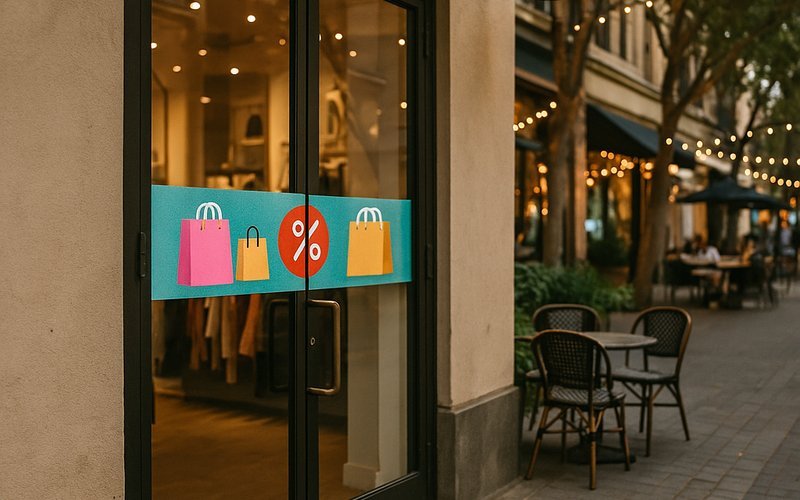
Retailers in Santana Row are using LED film mainly for seasonal promotions and brand campaigns that rotate every few weeks, while Willow Glen’s smaller boutique storefronts along Lincoln Avenue tend to use it for subtler, slower-motion graphics that fit the district’s walkable, less flashy retail feel.
Santana Row’s higher foot traffic and larger glass storefronts make it a natural fit for brighter, higher-pitch displays showing full-motion video, think holiday campaigns, new product launches, or store-wide sale announcements that change out monthly. Because many buildings there were constructed with retail-grade electrical infrastructure already in place, installation tends to move faster with fewer surprises.
Willow Glen looks different. A boutique retailer near Lincoln Avenue recently installed LED film on a 60 sq ft storefront window for $14,500, using a wider 10mm pitch specifically to keep the display subtle and match the neighborhood’s low-key commercial character. Instead of full video, they run slow crossfade graphics: seasonal color palettes, quiet text animations, nothing that competes visually with the district’s older architecture.
That contrast says a lot about how the technology adapts. LED film isn’t one-size-fits-all in San Jose, it flexes to whatever the corridor calls for. A jewelry store near Santana Row might want punchy, saturated motion graphics to catch eyes from across the plaza. A Willow Glen coffee shop wants something that reads as ambient, not aggressive. Both use the exact same underlying technology, just tuned differently through pitch, brightness, and content pacing.
What Are the Disadvantages of LED Film on Storefront Windows?
The main disadvantages of LED film are upfront cost, ongoing content management, and reduced clarity at night when the display is fully lit at high brightness. It’s not a cheap upgrade, and it’s not something you install and forget.
Cost is the obvious one. At $180 to $400 per square foot, LED film costs considerably more than static window graphics or standard vinyl signage. For a small storefront, that’s still a five-figure investment, and it only makes financial sense if you’re actually using the display regularly, not just running one static logo indefinitely.
Content upkeep is the less obvious cost. Someone needs to design, schedule, and update what’s playing, whether that’s a marketing employee or an outside agency. A display running the same stale content for eight months stops working as a marketing tool and starts looking neglected.
Night visibility is a real tradeoff too. At full brightness after dark, LED film can appear almost opaque from certain angles, briefly losing the see-through effect that makes it appealing during the day. Good installers program brightness to auto-dim in the evening, but if that’s set up poorly, your storefront can go from an elegant transparent display to a glaring wall of light after sunset. Honestly, most contractors will tell you this is the single most common complaint from retailers who bought the cheapest available system.
How Long Does LED Film Last Before It Needs Replacing?
Quality LED film typically lasts 8 to 10 years before brightness degrades enough to warrant replacement, assuming it’s run at reasonable brightness levels and not left on 24/7 at maximum output. Cheaper film can start visibly dimming within 3 to 4 years.
LEDs degrade gradually rather than failing all at once, which means the brightness drop is often subtle enough that owners don’t notice for a year or two. The rate of degradation depends heavily on how many hours per day the film runs and at what brightness. A storefront running content 12 hours a day at 70% brightness will outlast one running 18 hours a day at full brightness by several years.
San Jose’s climate is a modest factor too. Storefronts with heavy direct sun exposure, particularly south- and west-facing windows along wider corridors, run slightly hotter behind the glass, and heat accelerates LED degradation over time. Film installed with proper thermal venting handles this fine, but budget film without adequate heat management can shorten that lifespan by 2 to 3 years.
Warranty coverage is the practical way to judge quality upfront. Reputable installers offer 3 to 5 year warranties on the film itself and separate coverage on the control hardware, which tends to fail before the LEDs do. If a quote comes in noticeably cheaper than others with no meaningful warranty attached, that’s usually a sign of shorter lifespan, not a better deal.
LED Film vs. Smart Film vs. Smart Glass: Which One Fits Your San Jose Storefront?
LED film is for storefronts that want to display moving content, video, or graphics through the glass. Smart film and smart glass are for storefronts that want to control privacy or opacity, switching glass from clear to frosted on demand, and don’t serve the same purpose at all.
It helps to think of these as three different tools solving three different problems. LED film turns glass into a transparent screen, useful for marketing, promotions, and branding. Smart film, an adhesive-applied retrofit product, switches between clear and frosted with the flip of a switch, useful for conference rooms, treatment rooms, or storefronts that need occasional privacy without permanent curtains. Smart glass is the built-in version of the same privacy technology, laminated into the glass unit itself during manufacturing rather than applied after the fact.
A San Jose retailer trying to decide between these should start with the goal. If you want customers to see moving promotional content from the sidewalk, LED film is the right category. If you want a fitting room, back office, or private consultation area visible from the storefront to disappear behind frosted glass at the push of a button, smart film or smart glass solves that instead. Some businesses, particularly medical and wellness storefronts, actually use both: LED film on the public-facing window and smart film on interior partitions. For a full side-by-side, this guide to where smart glass demand is growing in San Jose covers how local businesses are combining these technologies by neighborhood.
How Do You Find the Right LED Film Installer in San Jose?
The right LED film installer in San Jose is one who can show completed local installs, explains pixel pitch and nit rating clearly without pushing you toward the most expensive option, and coordinates directly with a licensed electrician on permit filing. Anyone who can’t answer basic questions about brightness rating for your window’s sun exposure isn’t the right fit.
Start by asking to see photos or a site visit of a storefront they’ve installed with similar sun exposure to yours, ideally something facing a comparable direction along a similar corridor. An installer who’s done work on South First Street or near Santana Row will already understand San Jose’s permitting process and won’t be learning the Building Division’s requirements on your dime.
Ask specifically about warranty terms on both the film and the control hardware, since hardware failure is more common than LED degradation in the first few years. And ask who pulls the electrical permit, if one’s needed, since that responsibility should be spelled out in writing before work starts, not figured out after an inspector shows up.
- Request examples of installs on storefronts with similar sun exposure and glass size
- Confirm pixel pitch and nit rating recommendations specific to your window’s orientation
- Get warranty terms in writing for both film and control hardware
- Clarify who handles electrical permitting with San Jose’s Planning, Building and Code Enforcement Department
- Ask for a maintenance or content-update plan, not just an install quote
Pacific Smart Glass installs LED film across the Bay Area and works directly with San Jose retailers on everything from pixel pitch selection to permit coordination. If you’re ready to move past researching how LED film works on a storefront window in San Jose and want a real quote for your building, reach out through Pacific Smart Glass’s Bay Area LED film page for a site assessment and pricing specific to your storefront.