
Quick Answer: Smart glass conference room Los Angeles cost typically runs $85 to $175 per square foot installed, or roughly $18,000 to $42,000 for a standard 200-square-foot glass wall system. Los Angeles TI budgets favor smart glass over drywall-plus-blinds buildouts because it avoids a second construction trade and speeds up tenant improvement timelines in buildings governed by the Los Angeles Department of Building and Safety (or the applicable local building department for suites outside LA city limits, such as Culver City).
Facilities managers across Los Angeles keep asking the same question before they sign off on a conference room buildout: what does smart glass actually cost, and is it worth it over a standard drywall-and-blinds approach? The short answer is that a full smart glass conference room in Los Angeles costs $18,000 to $42,000 installed for a typical 200-square-foot wall system, depending on whether you choose smart film retrofit, laminated smart glass, or add LED film for branding. Los Angeles office leases increasingly reward tenants who can show flexible, private meeting space during a walkthrough, which is why this cost question comes up so often during TI planning in Downtown LA and Culver City creative offices (a neighboring city with its own permitting jurisdiction). This guide breaks down real per-square-foot numbers, what drives the price up or down, and how smart glass stacks up against traditional buildout costs in this market. Get a free estimate from a licensed Los Angeles smart glass installer before you lock in your TI budget.
How Much Does a Smart Glass Conference Room Cost in Los Angeles?
A smart glass conference room in Los Angeles costs $85 to $175 per square foot installed, which puts a typical 8-foot by 25-foot glass wall system (roughly 200 square feet) at $18,000 to $42,000 depending on the product tier and framing. That number includes the switchable glass or film, the transformer and control system, and professional installation, but it doesn’t include electrical rough-in if your suite doesn’t already have power near the wall location.
Pricing splits into three rough tiers depending on what you’re installing and how the space is built out. A smart film retrofit onto existing glass costs the least because you’re not replacing the glazing itself. A full laminated smart glass panel system costs more but lasts longer and looks cleaner from the edges. Adding LED film for logo displays or dynamic branding on top of either option adds a separate line item.
| Project Type | Cost Per Sq Ft | Typical 200 Sq Ft Room Total | Timeline |
|---|---|---|---|
| Smart film retrofit (existing glass) | $45–$85 | $9,000–$17,000 | 1–3 days |
| Standard switchable smart glass wall | $85–$140 | $17,000–$28,000 | 4–8 weeks (lead time + install) |
| Blackout-grade smart glass + framing | $120–$175 | $24,000–$35,000 | 5–9 weeks |
| Smart glass + LED film branding layer | $150–$220 | $30,000–$44,000 | 6–10 weeks |
A creative office tenant in Silver Lake recently installed a 210-square-foot smart glass conference room wall for $31,500, choosing the mid-tier switchable glass option because their landlord required framing that matched existing anodized aluminum storefront mullions. That kind of building-specific requirement is common in older Los Angeles buildings that have been converted to creative office space, and it’s worth asking your installer to price against your actual mullion profile before you get a final number.
What Drives the Price of Smart Glass Partitions in an LA Office?
Four factors move the price most: glass size and configuration, framing material, control complexity, and access. A single fixed panel costs far less per square foot than a wall with an integrated door, because doors need hinges, seals, and often a separate control zone.
Building access is a bigger factor in Los Angeles than people expect. High-rise office towers in Downtown LA often require freight elevator scheduling, insurance certificates, and after-hours install windows, all of which add labor cost even before the glass goes in. A ground-floor creative office in a separate city like Culver City, which has its own permitting process, skips most of that overhead entirely.
Control complexity matters too. A single switchable panel with one wall switch is simple. A conference room with multiple zones, app control, and integration with a room-booking system or building automation platform costs more in both hardware and programming time. And framing choice swings cost noticeably: a minimalist frameless glass-to-glass butt-joint system costs more per foot than a standard aluminum frame, but it’s what most Los Angeles creative offices want for the look.
- Panel size and door cutouts: larger continuous panels cost less per square foot than multiple smaller ones with a door
- Framing material: aluminum frame systems run cheaper than frameless glass-to-glass installs
- Control system: single-switch control is standard; app-based or multi-zone control adds $1,500–$4,000
- Building access: high-rise freight elevator scheduling and after-hours labor in Downtown LA towers can add 10–15% to install cost
- Electrical rough-in: if the wall location lacks nearby power, expect an added electrician line item of $800–$2,200
Smart Film vs. Smart Glass vs. LED Film: Which Fits Your Conference Room?
Smart film works best as a retrofit onto existing glass at the lowest cost, standard smart glass works best for new partition walls that need long-term durability, and LED film works best as a branding or wayfinding layer on top of either. Most Los Angeles conference room projects use one primary product with LED film added only if branding matters to the client experience.
| Product | Best For | Cost Range (per sq ft) | Lifespan |
|---|---|---|---|
| Smart Film | Retrofitting existing glass walls or windows | $45–$85 | 8–12 years |
| Smart Glass (laminated) | New partition walls, higher-traffic doors | $85–$175 | 15–25 years |
| LED Film | Logo displays, branded dividers, dynamic signage | +$40–$70 (added to base product) | 10–15 years |
Honestly, most facilities managers default to smart film first because it’s cheaper and faster, but that’s not always the right call for a conference room that gets heavy daily use. Smart film applied to existing glass can bubble or delaminate at the edges faster than laminated smart glass, especially near door handles and high-touch zones. If your conference room is a permanent fixture and the wall is being built new anyway, laminated smart glass is usually the better long-term spend even though it costs more upfront.
LED film is a different decision entirely. It’s not a privacy product, it’s a display product, and it only makes sense if you want a branded logo or pattern visible when the glass is in its opaque or on state. A few Downtown LA agencies have added LED film to their client-facing conference room glass specifically so the room reads as a design statement during tours, not just a functional space.
Smart Glass vs. Drywall Buildouts: What Actually Costs Less in Los Angeles?
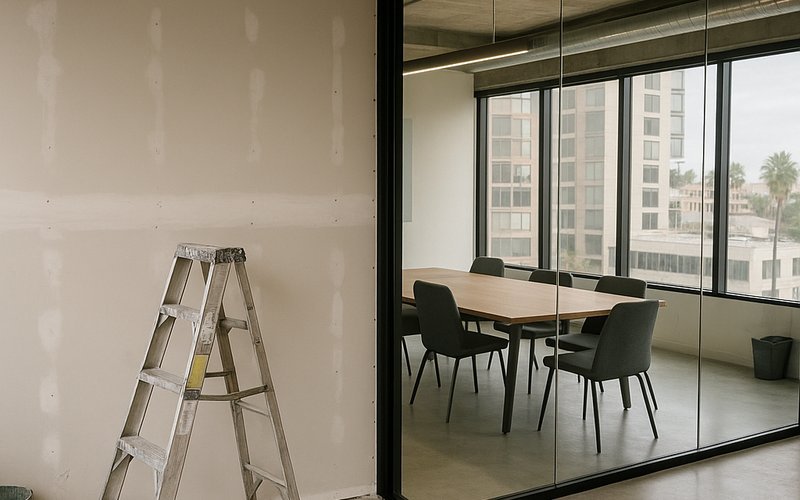
Drywall buildouts with blinds cost less upfront per square foot in Los Angeles, typically $35 to $60 per square foot including framing, drywall, paint, and mechanical blinds, but smart glass usually costs less over the life of a 5 to 10 year lease when you account for construction trades, timeline, and re-lease flexibility.
Here’s the part most contractors won’t walk you through unprompted: a drywall wall isn’t just drywall. It’s framing, electrical for lighting, drywall hang and finish, paint, and then a separate blinds or shade installer. That’s four trades scheduled in sequence, and in Los Angeles that sequencing alone can add 2 to 4 weeks to your buildout timeline compared to a single smart glass installer showing up once.
A coworking operator in Downtown LA compared both approaches for a 6-room buildout on a recent lease. The drywall-and-blinds path priced out around $46 per square foot but required five separate trade visits and a three-week schedule. The smart glass path priced at $98 per square foot but installed in nine days with one crew, and it let them show the space as flexible, glass-walled premium inventory to prospective members, which mattered more to their leasing pitch than the raw dollar difference.
So which actually costs less? If you’re optimizing purely for the lowest number on a TI allowance line item, drywall wins. If you’re optimizing for total project time, fewer trade coordination headaches, and a room that reads as premium to tenants or clients, smart glass usually wins in this market. If you’d like an accurate quote for your specific suite, a Los Angeles installer can walk both numbers side by side against your actual TI allowance.
Why Are Los Angeles Coworking and Creative Offices Switching to Smart Glass Partitions?
Los Angeles coworking operators and creative agencies are switching to smart glass conference room partitions because instant privacy switching lets them market the same room as both an open, transparent space and a private meeting room, without owning two different rooms. In a leasing market where every square foot of usable, flexible space matters, that dual function is a real differentiator during tours.
Creative offices in particular like the daylight argument. Open floor plans in converted warehouse spaces around Culver City and the Arts District depend on natural light reaching deep into the floor plate. A drywall conference room blocks that light entirely. A smart glass conference room keeps the room transparent and bright most of the day, then switches opaque in seconds when a call needs privacy.
Coworking operators have a second reason: member perception. A glass-walled room with switchable privacy photographs better for marketing, tours better for prospective members, and signals a modern space without the operator needing to explain anything. It’s become close to a baseline expectation in newer Los Angeles coworking builds rather than a premium upgrade.
If you’re scoping which building types benefit most from this switch, Pacific Smart Glass’s guide on who needs smart glass in commercial buildings breaks down the specific building categories, from coworking to medical to legal offices, where the ROI case is strongest.
Is Blackout Smart Glass Worth It for Client-Facing Meeting Rooms?
Blackout smart glass is worth the added cost for client-facing meeting rooms where confidentiality matters, such as legal, entertainment, or finance offices common in Los Angeles, but it’s overkill for a general team huddle room. Blackout-grade glass runs $120 to $175 per square foot versus $85 to $140 for standard switchable glass, a premium of roughly 20 to 30%.
The difference isn’t cosmetic. Standard switchable smart glass frosts to an opaque white state that blocks visual line of sight but still transmits some light and vague shapes at close range. Blackout smart glass uses a different liquid crystal formulation or an added film layer to fully block light transmission, which matters for entertainment industry conference rooms in Los Angeles where screenplay pages, deal terms, or unreleased content might be visible on a screen through standard glass.
A talent agency office near Culver City chose blackout-grade glass specifically for one conference room used for script reviews, while keeping standard switchable glass on three other rooms used for general meetings. That mixed approach is common and it’s the right instinct: you don’t need blackout-grade glass on every wall, just the ones where the content in the room genuinely needs full visual blocking, not just privacy from casual glances.
What Permits Do You Need for Smart Glass in a Los Angeles Office Buildout?
Most smart glass installations in Los Angeles that replace existing glass in the same opening without altering structural framing don’t require a separate building permit, but any project that involves new wall framing, electrical circuits, or occupancy changes needs to go through the Los Angeles Department of Building and Safety as part of your standard tenant improvement permit.
The line that matters most is electrical. Smart glass and smart film both require low-voltage wiring to a transformer, and if that wiring is new construction rather than a plug-in retrofit, it typically falls under your TI electrical permit scope, which your general contractor or electrician pulls through LADBS as part of the broader buildout. If you’re only replacing existing glass panes with smart glass in the identical opening and using existing power, many Los Angeles landlords and building departments treat it as a non-structural finish and don’t require a separate permit.
Buildings inside a historic overlay zone or in a building with Certificate of Occupancy restrictions can have additional review steps, so it’s worth confirming with your landlord’s building management office before ordering glass, especially for older converted buildings in the Arts District or historic Downtown LA cores. Your smart glass installer should coordinate directly with your general contractor and electrician so permit scope, if needed, gets bundled into the existing TI permit rather than filed separately.
How Do You Find the Right Smart Glass Installer in Los Angeles?
The right smart glass installer in Los Angeles is a company with direct commercial installation experience, not just residential window film work, and one that can show project photos from actual Los Angeles office buildouts rather than stock renderings. Ask for at least two references from commercial clients in the past 18 months.
Start by asking how the installer sources their glass and control systems. Some installers manufacture or import their own switchable glass and film, which usually means better lead times and warranty support, while others resell third-party product with an added markup and slower support if something fails. Ask specifically what warranty covers the film or glass versus the transformer and controls, since those often come from different manufacturers with different coverage terms.
You’ll also want to confirm they carry proper contractor licensing for commercial work in California and can pull or coordinate permits with your general contractor when needed. A good installer will walk your space, measure existing openings, and give you a written quote broken out by material, labor, and controls, not one lump-sum number.
- Ask for photos or a walkthrough of a completed Los Angeles commercial conference room project
- Confirm whether they manufacture their own smart film and glass or resell third-party product
- Get warranty terms in writing for both the glass/film and the transformer/control system separately
- Confirm they’ll coordinate directly with your general contractor and electrician on permit scope
- Request an itemized quote broken out by material, labor, and controls, not a single lump sum
Ready to scope your conference room buildout? Reach out to a Los Angeles smart glass installer for a walkthrough and itemized quote before you finalize your TI budget, and compare it against your drywall alternative line by line so you’re deciding with real numbers, not estimates.