
Quick Answer: Smart glass for a smart glass photography studio Los Angeles setup typically runs $35–$65 per square foot installed, or $18–$30 per square foot for retrofit smart film on existing windows. Most single-room studios in the Arts District or Culver City spend $8,000–$22,000 total. The right choice depends on whether you’re renting your space, how often you switch between natural-light and blackout shoots, and whether soundproofing matters for talent sessions.
Every LA photo studio owner knows the drill: you book a natural-light shoot at 10am, then a confidential talent session at 2pm that needs full blackout and privacy. Smart glass and smart film solve this by switching from clear to opaque in under a second, at a cost of $18–$65 per square foot depending on whether you’re installing new smart glass panels or retrofitting existing windows with smart film. Los Angeles studios face a specific problem here: many production spaces in converted warehouses and industrial buildings have massive street-facing windows with zero window treatments, and the City of Los Angeles Building and Safety Department treats film retrofits very differently than structural glass replacement for permitting purposes. This guide walks through real costs, the difference between smart film and full smart glass, why studios in the Arts District and Culver City are making the switch, and how to find an installer who actually understands production workflows. Get a free estimate from a licensed Los Angeles smart glass installer before your next lease renewal or buildout.
What Does Smart Glass Cost for a Los Angeles Photo Studio?
In Los Angeles, smart glass installation for a photography studio costs $35–$65 per square foot for new laminated PDLC panels, while retrofit smart film on existing glass runs $18–$30 per square foot. A typical 400 sq ft studio wall of windows lands between $8,000 and $22,000 depending on the system and controls package.
Your final number depends on three things: whether you’re doing new glass or film retrofit, how many independent zones you want controlled separately, and whether you need a soundproofing laminate layer built in. Studios that shoot both bright, natural-light editorial work and dark, controlled video content usually want zoned control, which adds cost but lets you blackout half a wall while keeping the other half clear for a background.
| Option | Cost per Sq Ft | Typical Studio Cost (300–500 sq ft) | Switch Speed |
|---|---|---|---|
| Smart film retrofit (PDLC) | $18–$30 | $5,400–$15,000 | Under 1 second |
| New smart glass panels | $35–$65 | $10,500–$32,500 | Under 1 second |
| LED film wall system | $25–$45 | $7,500–$22,500 | Instant, plus color/pattern control |
| Manual blackout rigging | $8–$15 | $2,400–$7,500 | 3–10 minutes, requires crew |
A production studio in the Arts District recently converted six large industrial window bays to smart film for $14,200, splitting the wall into three independently controlled zones. That let them run a natural-light lookbook shoot in one zone while a video crew shot blackout content ten feet away, something impossible with fixed rigging. If you’d like an accurate quote for your specific studio layout, this room-by-room pricing breakdown is a useful starting point before you call anyone.
How Does Smart Glass Give Studios Instant Control Over Natural Light?
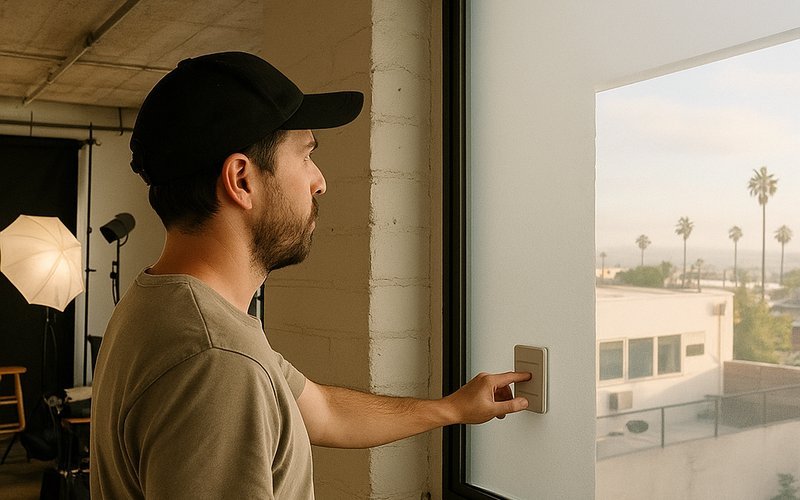
Smart glass uses a PDLC (polymer dispersed liquid crystal) layer that switches from clear to a milky, light-diffusing opaque state the instant you flip a switch or tap an app. There’s no manual rigging, no C-stands with duvetyne, no crew standing by to pull curtains between setups.
For a photography studio, this changes how you book the day. You can run a bright editorial shoot using full window light in the morning, then flip the glass to opaque in seconds for a controlled studio-lighting setup in the afternoon, without losing shoot time to physical light blocking. Some systems also offer a dimmed, frosted “diffusion” mode between fully clear and fully opaque, which acts like a giant softbox for window-light portrait work.
Studios running back-to-back bookings feel this most. A typical rigging changeover between a natural-light shoot and a blackout video shoot takes 15–30 minutes with sandbags, clamps, and blackout fabric. Smart glass cuts that to seconds, which over a busy month can recover several billable hours. Zoned control matters here too: a studio can wire separate window sections to separate switches, so a background wall stays clear for an Instagram-style shoot while the rest of the room goes dark for talent privacy.
Smart Film, Smart Glass, or LED Film: Which Fits a Los Angeles Studio Best?
Smart film is the right choice for studios retrofitting existing windows on a lease, smart glass makes sense for owned buildings doing a full buildout, and LED film fits studios that want programmable lighting effects built into their walls, not just privacy control.
Smart film installs directly onto your existing glass, which is why it’s the most common choice for LA studios operating in leased warehouse and loft spaces where you can’t touch the building’s structural glazing. It’s removable, which matters if your lease ends and you don’t own the building. Smart glass, by contrast, replaces the glass unit itself, usually during a buildout or new construction, and offers slightly better clarity and longevity since the PDLC layer is factory-laminated rather than field-applied.
| System | Best For | Lease-Friendly? | Lifespan |
|---|---|---|---|
| Smart film | Retrofitting existing studio windows | Yes, removable | 10–15 years |
| Smart glass panels | New buildouts, owned buildings | No, permanent | 20–25 years |
| LED film | Programmable backdrops, brand activations | Yes, removable | 8–12 years |
Honestly, most studio owners in Culver City go with smart film first, since it’s a fraction of the cost of tearing out glazing on a rented space, and it still delivers the same near-instant switching speed as full smart glass. If your studio doubles as a rental space for brand shoots, LED film is worth a look too, since it can display branded patterns or colored light directly on the glass between clients. For a deeper comparison of film versus older methods, see this breakdown of smart film versus curtains.
Why Are Los Angeles Production Studios Switching to Smart Glass?
Los Angeles production studios are switching to smart glass because it eliminates the daily rigging labor cost, protects client privacy during confidential talent shoots, and lets a single room serve multiple booking types without a physical reset. For a city with this much booked-studio turnover, that flexibility translates directly into revenue.
A studio that can only shoot natural light loses the entire video and podcast market. A studio that’s permanently blacked out loses the daylight-editorial and lifestyle-brand clients who specifically want window light in frame. Smart glass photography studio setups in Los Angeles solve this by making the same square footage bookable for both, often doubling the types of shoots a single room can host in a week.
There’s also a staffing angle. Rigging blackout takes a production assistant or gaffer’s time, and that’s billable labor most small studios can’t spare. A studio owner who used to schedule 20-minute buffers between every booking to swap lighting conditions can often cut that to under five minutes with switch-glass, which over a full month of bookings adds real capacity without adding square footage. Some studios in Highland Park have started marketing “instant blackout” as a feature in their booking listings, since renters searching for confidential shoot space specifically look for that capability.
Which Los Angeles Creative Districts Are Installing Smart Glass Right Now?
The Arts District, Culver City, and Highland Park are the three Los Angeles neighborhoods seeing the heaviest smart glass adoption among photo and video studios, driven by their concentration of converted warehouse and loft production spaces with large street-facing glazing.
In the Arts District, many studios operate out of former industrial buildings with floor-to-ceiling window walls that were never designed with privacy or light control in mind. Owners here are retrofitting those windows with smart film rather than building out interior walls, since the exposed-brick, big-window aesthetic is part of what clients are paying to book.
Culver City’s studio corridor, close to the major production lots, sees a different pattern: studios booked by agencies and post-production houses for talent-facing content need fast blackout for privacy far more often than they need daylight, so many install smart glass in zoned sections rather than across an entire wall. Highland Park’s smaller, boutique studio spaces tend to favor smart film retrofits because the buildings are older and owners are often renting rather than owning. If you want a broader look at where these installs are concentrated across the city, this neighborhood buyer’s guide covers it in more depth.
Does Smart Glass Improve Soundproofing and Privacy for Talent Shoots
Smart glass with a laminated PDLC interlayer adds meaningful acoustic dampening compared to standard single-pane studio windows, typically reducing sound transmission by several decibels, though it is not a substitute for dedicated acoustic treatment on shared walls.
For studios booking confidential talent sessions, celebrity shoots, or brand content under NDA, the privacy layer matters as much as the sound layer. A frosted-opaque window facing a street or shared hallway means passersby and building neighbors can’t see who’s inside, which is a real concern for studios in ground-floor Arts District spaces with heavy foot traffic just outside the glass.
The laminated glass structure used in most smart glass systems includes an interlayer similar to standard security laminate, which cuts down on both light transmission and mid-frequency sound compared to a bare pane. Studios pairing smart glass with acoustic panels on adjacent walls get the best of both: visual privacy that switches instantly, and sound isolation that keeps confidential conversations and dialogue recording clean. It won’t replace a purpose-built sound booth, but for general studio privacy between a public-facing storefront and the shooting floor, it closes a real gap that curtains never could.
Do You Need a Permit for Smart Glass in an LA Studio Space?
In most cases, applying smart film to existing glass in a Los Angeles studio does not require a permit, since it’s classified as a window treatment rather than a structural alteration. Installing new smart glass units that replace structural glazing does typically require a permit through the Los Angeles Department of Building and Safety.
The distinction matters because it directly affects your timeline and budget. A film retrofit can usually be scheduled and completed within 1–3 days with no inspection required, since you’re not altering the building envelope. Replacing glazing units, especially in a commercial building with occupancy requirements, may require plan check and an electrical permit if the glass is wired to a dedicated low-voltage control system.
If your studio is in a leased space, check your lease agreement before any installation, since some commercial leases restrict alterations to the building’s exterior-facing glass even for film. Studios in converted industrial buildings sometimes fall under different zoning designations than standard commercial storefronts, which can affect what the Los Angeles Department of Building and Safety requires for glazing changes. A licensed installer familiar with LA commercial permitting should be able to tell you within a day whether your specific project needs a permit or not, before any work starts.
How to Find the Right Smart Glass Installer for Your Los Angeles Studio
Look for a Los Angeles smart glass installer with direct commercial production experience, not just residential window film work, since studio installs involve zoned wiring, control app integration, and often tight turnaround windows between bookings.
Ask any installer bidding on your smart glass photography studio project in Los Angeles how many zones they can wire independently, what the switch speed is on their specific film or glass product, and whether they’ve worked in converted warehouse or loft buildings before. Those buildings often have unusual glazing sizes and older electrical panels that not every installer is equipped to handle cleanly.
- Confirm they carry commercial glazing and electrical licensing valid in Los Angeles
- Ask for photos or references from other LA production studios, not just homes
- Get a written switch-speed and warranty spec, not a verbal estimate
- Confirm whether the quote includes a smartphone or wall-panel control system
- Ask how they handle after-hours installs, since most studios can’t lose a booking day
Pacific Smart Glass has installed smart film, smart glass, and LED film systems across Los Angeles production spaces, from single-window retrofits to fully zoned multi-room studios. You can see examples of completed Los Angeles installations and request a walkthrough of your specific space before committing to a system. Whether you’re weighing smart film against a full glass replacement, or trying to figure out if LED film makes more sense for a branded backdrop, getting a firm, written quote from a licensed local installer is the only way to know your real number. Reach out for a free on-site estimate before your next studio buildout or lease renewal, so you know exactly what instant light control will cost for your room.