
A lockdown drill at a Los Angeles campus shouldn’t come down to whether someone remembered to close the blinds. That’s the real problem facility managers are solving right now, and the growing demand for smart glass schools universities Los Angeles institutions rely on shows switchable smart glass is the fix: it turns a classroom window from clear to opaque in under one second at the flip of a switch, no blinds, no paper covering the glass, no scrambling. In Los Angeles, this matters because many campus buildings still have older aluminum-frame windows that were never designed with lockdown privacy in mind, which makes retrofitting with smart film a faster path than full window replacement. This guide covers real costs, lockdown compliance, which Los Angeles campuses are already using it, and how to pick an installer who understands school facilities. Get a free estimate from a licensed installer before your next budget cycle closes.
What Is Smart Glass and Why Are Los Angeles Schools Installing It?
Smart glass (also called switchable privacy glass) uses a layer of liquid crystal film sandwiched between glass or applied as a retrofit film. When power is applied, the crystals align and the glass turns clear. Cut the power, and it turns milky white and opaque almost instantly. Schools are installing it for one main reason: it gives teachers a way to black out a classroom window in a fraction of a second without touching blinds, curtains, or paper.
Los Angeles campuses have been under pressure to modernize lockdown protocols for years, and traditional window coverings keep showing up as a weak point in safety audits. Blinds get stuck. Paper falls down. A teacher managing 30 students during an actual emergency doesn’t have time to fumble with a cord. Smart glass removes that failure point entirely.
There’s also a daytime-use case that facility managers appreciate: the same glass that goes opaque for a drill can also provide privacy for testing, counseling offices, nurse’s stations, and administrative areas, all without a separate switch or blind system. It’s one piece of glass doing several jobs, which is part of why it’s showing up in more Los Angeles capital improvement plans each year.
How Much Does Smart Glass Cost for Los Angeles Schools and Universities?
In Los Angeles, smart glass for school and university buildings typically runs $45–$95 per square foot installed, with full classroom retrofits landing between $3,800 and $9,500 per room depending on window count and glass size. Smart film applied to existing glass is the lower-cost option; full switchable glass unit replacement costs more but lasts longer and holds up better under heavy campus use.
| Option | Cost Range (installed) | Best For | Typical Timeline |
|---|---|---|---|
| Retrofit smart film on existing glass | $45–$65 per sq ft | Older buildings, tight budgets, phased rollouts | 1–2 days per classroom |
| Full smart glass unit replacement | $70–$95 per sq ft | New construction, renovations, high-traffic corridors | 3–5 days per room |
| LED film accent glazing | $55–$80 per sq ft | Lobbies, common areas, wayfinding | 2–3 days |
Budget also depends on wiring. Many older Los Angeles school buildings need new low-voltage runs to each window, which adds to labor cost but is usually a one-time expense. A district converting an entire wing, say 12 to 15 classrooms, often sees per-unit pricing drop because of shared labor and electrical work across rooms.
For universities, the math shifts slightly. Lecture halls with larger glass panels cost more per room but less per square foot, since installers aren’t repeating setup across dozens of small openings. If you’d like an accurate quote for your specific building or campus wing, a smart glass installer familiar with school facility requirements can walk the site and give you real numbers instead of a rough estimate.
Can Smart Glass Meet Lockdown and Active Shooter Safety Protocols in Los Angeles?
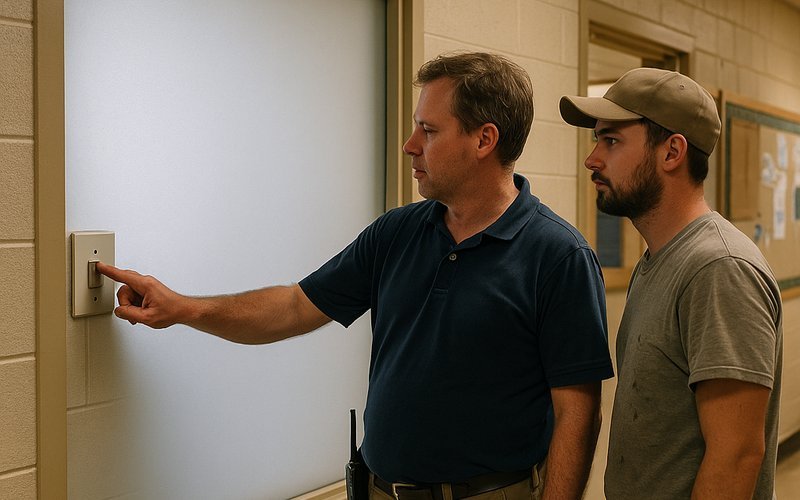
Yes. Smart glass switches from clear to fully opaque in under one second, which meets the visual-concealment requirement built into most Los Angeles-area lockdown protocols. It does not replace door locks, reinforced frames, or physical barriers, but it closes the specific gap where classroom windows leave students visible from hallways during a lockdown.
Lockdown protocols generally require two things from windows: the room needs to go visually opaque fast, and it needs to stay that way without anyone holding a switch. Smart glass satisfies both. Most systems tie into a wall-mounted switch or a central control panel, so a single override can black out an entire wing at once rather than relying on each teacher individually.
What Smart Glass Does Not Replace
Honestly, most safety consultants will tell you smart glass is one layer in a broader plan, not a stand-alone fix. It should be paired with:
- Reinforced door frames and classroom locks that can be secured from inside
- Clear evacuation routes and drill schedules already required by district policy
- A central override switch so administration can activate opacity building-wide during an actual emergency
- Backup power or battery failover so the glass stays opaque even during a power outage
That last point matters more than people expect. A school investing in smart glass for safety reasons should always ask the installer about battery backup options, since a glass system that only works with power defeats part of the purpose.
Which Los Angeles Campuses Are Already Using Smart Glass?
Several Los Angeles-area campuses have moved on smart glass installations as part of broader facility modernization projects, particularly in buildings where window replacement was already scheduled. University buildings undergoing renovation are a natural fit, since smart glass gets specified during the same construction phase as new HVAC or electrical upgrades, avoiding a second disruption to classes.
Private schools have also been early adopters, largely because their facilities committees can move faster than a public district’s capital budget cycle. A private school renovating a science wing, for example, might add smart glass to lab windows and administrative offices in the same project phase as new lighting, since the electrical contractor is already on site running wire.
Public school buildings tend to adopt smart glass in phases, starting with high-visibility areas: front offices, main entrances, and ground-floor classrooms that face parking lots or public sidewalks. These are the windows most exposed during a lockdown, so they’re usually first in line for retrofits even when a full building upgrade is years away.
Smart Film vs. Smart Glass vs. LED Film: Which Fits a School Building Best?
Smart film is the best fit for retrofitting existing school windows on a budget, smart glass is better for new construction or full window replacement, and LED film works well for common areas needing both privacy and visual display capability. Most Los Angeles school projects use a mix of all three depending on the room’s function.
| Product | Applied To | Best Use in Schools | Cost Range |
|---|---|---|---|
| Smart Film | Existing glass (retrofit) | Classrooms, offices, nurse’s stations | $45–$65/sq ft |
| Smart Glass | New glazing unit | New construction, renovated wings, lecture halls | $70–$95/sq ft |
| LED Film | Existing or new glass | Lobbies, wayfinding, digital signage integration | $55–$80/sq ft |
Smart film is the practical choice for most Los Angeles schools because it works on the windows already in the building. No demolition, no reframing, just a film application that bonds to the existing glass and wires into a switch. It’s the fastest way to get a classroom lockdown-ready without pulling permits for structural changes.
Smart glass, the full replacement version, makes more sense when a building is already getting new windows for other reasons, like energy efficiency upgrades or a facility-wide renovation. Since the labor to remove and reinstall glazing is happening anyway, upgrading to switchable glass at that point adds less incremental cost than doing it as a stand-alone project later.
LED film is a smaller piece of most school projects but shows up in newer builds where administrators want digital wayfinding or announcements integrated into glass surfaces in main lobbies. It’s less about safety and more about modernizing common spaces, though some districts pair it with privacy glazing in the same renovation phase.
What Permits Do Los Angeles Schools Need for Smart Glass Installation?
In Los Angeles, smart film retrofits applied to existing glass generally do not require a building permit since they don’t alter the structure or glazing unit itself. Full smart glass replacement, which involves swapping the glazing unit, typically does require a permit through the Los Angeles Department of Building and Safety, especially in buildings governed by school facility codes.
Public school projects add another layer: the Division of the State Architect (DSA) reviews and approves construction on K-12 public school facilities statewide, and any structural glazing work on a DSA-approved building needs to go through that review process before installation. This applies to public Los Angeles Unified School District buildings specifically, not to private schools or university buildings, which fall under different review paths.
University buildings on campuses with their own facilities departments often manage permitting internally through their campus planning office, working alongside the City of Los Angeles Department of Building and Safety when off-campus contractors are involved. Private schools typically only need standard building permits when the work involves replacing glazing units, and can usually skip that step entirely with a film-based retrofit.
Because permit requirements shift so much between public K-12, private schools, and university buildings, it’s worth confirming your specific project’s requirements with your installer before signing a contract. A contractor experienced with Los Angeles school facilities will already know which path your building falls under.
How Do You Choose a Smart Glass Installer for a Los Angeles School or University?
Choose a smart glass installer in Los Angeles with direct experience on school or institutional buildings, not just residential or retail glass work. Ask for references from past school projects, confirm they carry commercial liability insurance appropriate for campus work, and get a written timeline that accounts for working around class schedules.
School facilities are different from a typical commercial job. Installers need to work around active class periods, coordinate with campus security for access, and often complete work during breaks or weekends to avoid disrupting instruction. An installer without that experience may quote a job accurately on paper but struggle with the actual logistics of a live campus.
Questions to Ask Before You Sign
- Have you completed installations on K-12 or university buildings in Los Angeles before, and can I speak with a facilities contact from that project?
- What’s your plan for working around active class schedules and campus security requirements?
- Does the switch system include battery backup in case of a power outage during a lockdown?
- What warranty do you offer on the film or glass, and does it cover heavy daily use in a classroom setting?
- Can you provide a written scope that separates film retrofit costs from any electrical work needed?
A facilities manager in Los Angeles recently retrofitted an entire administrative wing, roughly 14 windows across six offices, with switchable smart film over a single long weekend to avoid disrupting the school week. That kind of scheduling flexibility is exactly what separates an installer who understands campus work from one who’s only done residential or retail jobs. Pacific Smart Glass works directly with Los Angeles school facilities teams on projects like this, and you can request a quote through their smart glass service page to get a scope and timeline built around your campus’s actual schedule.
If your district or campus is weighing options for an upcoming budget cycle, don’t wait until the next safety audit forces the decision. Reach out to a licensed Los Angeles installer now, get a walkthrough scheduled, and get real numbers in front of your facilities committee before the next planning meeting. The sooner you have a scope and cost range in hand, the easier it is to get the project approved and installed before it becomes urgent.