
Smart glass isn’t a one-size-fits-all product, and while smart glass neighborhoods each have their own architectural quirks, the same is true across Los Angeles, where the neighborhood you live in changes what actually makes sense for your home. A 1920s Craftsman in Los Feliz has different glass, framing, and budget realities than a glass-walled estate in Bel Air or a loft conversion Downtown. In Los Angeles, the right choice usually comes down to three products: smart film for retrofits, full smart glass for new installs, and LED film for accent or commercial spaces. This guide breaks down which product fits which part of the city, what it costs by neighborhood, and how to avoid paying for the wrong system. Get a free estimate from a licensed Los Angeles smart glass installer once you know which category your home falls into.
Which Los Angeles Neighborhoods Are Best Suited for Smart Glass?
Los Angeles neighborhoods split into three practical categories for smart glass: older bungalow districts suited to smart film retrofits, hillside estate areas suited to full smart glass systems, and dense condo or loft districts suited to switchable partitions. The right product depends less on ZIP code and more on your window type, budget, and whether you’re renovating or building new.
In Silver Lake and Los Feliz, most homes date back to the 1920s through 1950s. Original single-pane windows and wood frames make full smart glass replacement expensive and sometimes structurally impractical, which is why smart film applied directly to existing glass is the more common upgrade here.
Bel Air and Beverly Hills sit at the other end. Newer construction and remodels in these neighborhoods often include floor-to-ceiling glass walls, pocket doors, and skylights built specifically to accommodate switchable glazing from the start, so a full smart glass system gets specified during design rather than retrofitted later.
Downtown LA lofts and West Hollywood condos fall in the middle. Large factory-style windows and open floor plans make switchable glass partitions a practical way to divide space without permanent walls, and it’s a feature buyers increasingly ask about during resale.
How Much Does Smart Glass Cost in Los Angeles by Neighborhood?
Smart glass in Los Angeles typically runs $25–$45 per square foot for smart film retrofits, $90–$150 per square foot for full smart glass systems, and $35–$60 per square foot for LED film accent installs. Your total project cost depends heavily on whether you’re applying film to existing glass or replacing panes entirely.
| Neighborhood Type | Typical Product | Cost Range | Typical Project Size |
|---|---|---|---|
| Silver Lake / Los Feliz bungalows | Smart Film retrofit | $1,800–$6,500 total | 2–4 windows, one room |
| Bel Air / Beverly Hills estates | Full Smart Glass system | $18,000–$65,000+ total | Glass walls, 200–600 sq ft |
| Downtown LA lofts / West Hollywood condos | Switchable Glass partition | $6,500–$22,000 total | One partition wall, 80–150 sq ft |
A homeowner in Los Feliz recently had smart film applied to four original double-hung windows in a 1928 Spanish-style home for $4,200, avoiding the cost and hassle of replacing historic wood sash frames. That’s the calculation most older-home owners in Los Angeles end up making: film preserves the original glass and frame while adding privacy control, and it costs a fraction of full replacement.
If you’d like an accurate quote for your specific windows or glass walls, Pacific Smart Glass offers free on-site estimates and can tell you within one visit which product fits your budget.
Silver Lake and Los Feliz: Where Smart Film Fits Bungalows and Older Windows
Smart film is the practical choice for Silver Lake and Los Feliz because most homes in these neighborhoods have original single-pane windows that aren’t good candidates for full glass replacement. Applying switchable film directly to existing panes adds privacy and light control without touching historic frames or triggering a larger remodel.
Many of these homes sit on hillside lots with windows facing directly onto neighboring properties or busy streets, which is exactly the situation smart film solves best. You flip a switch, the glass frosts, and you get privacy in seconds instead of pulling blinds or curtains across an awkward window shape.
It’s also non-invasive, which matters for owners of older homes who don’t want to void original window warranties or disturb lead paint on wood trim common in pre-1950s construction. Film installs in a single day for most rooms, with no demolition and no need to touch the surrounding wall or trim.
Honestly, most contractors will tell you full glass replacement isn’t worth it unless you’re already replacing the windows for other reasons. Smart film gets you 80% of the functionality at a fraction of the cost and disruption.
Bel Air and Beverly Hills: Full Smart Glass Systems for Estate-Scale Glass Walls
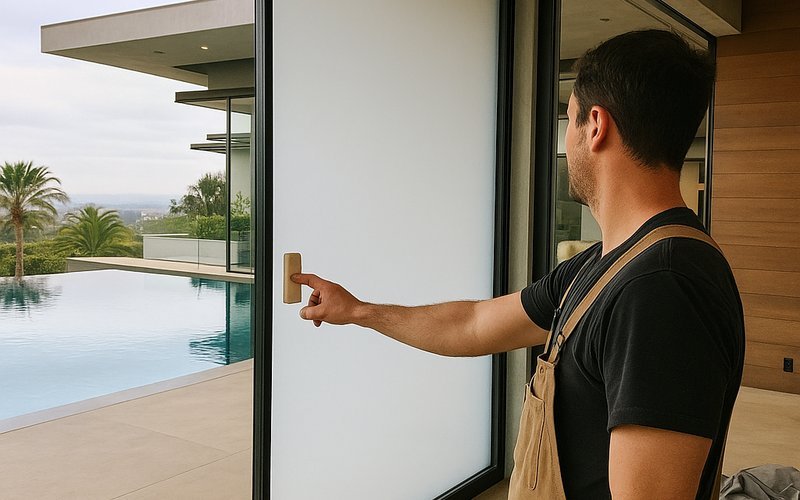
Full smart glass systems make sense in Bel Air and Beverly Hills because homes here often feature large-format glass walls, pocket doors, and skylights built into the original architecture rather than retrofitted later. At this scale, switchable film applied after the fact can’t match the clarity or seamless look that factory-laminated smart glass provides.
These estates typically involve glass walls in the 200 to 600 square foot range, sometimes larger for indoor-outdoor great rooms. At that size, full smart glass gets specified during design so the electrical wiring, low-voltage controls, and structural glazing all get built in together rather than added as an afterthought.
A homeowner in Bel Air recently completed a remodel that replaced a 340 square foot fixed glass wall separating an indoor living room from a covered patio with a full smart glass system integrated into a Lutron home automation setup. The project ran roughly $42,000 including electrical work, but it eliminated the need for exterior shades or curtains entirely on a wall with unobstructed hillside views.
If you’re planning a similar remodel, it’s worth reading how switchable glazing gets specified into luxury home remodels in Los Angeles before your architect finalizes glass specs, since retrofitting smart glass into an already-built structure costs significantly more than building it in from the start.
Downtown LA Lofts and West Hollywood Condos: Why Switchable Glass Adds Resale Value
Switchable glass partitions add resale value in Downtown LA and West Hollywood because they let buyers see flexible, private space without permanent walls, a feature increasingly common in listing photos and open-house walkthroughs. In dense condo and loft buildings, that flexibility often matters more to buyers than square footage alone.
A one-bedroom loft in a converted Downtown LA building might use a switchable glass partition to separate a home office nook from the main living space. Frosted, it reads as a private room. Clear, it opens the whole floor plan back up, which matters in units where every square foot gets counted during a sale.
West Hollywood condo buildings with HOA restrictions on structural walls are another common use case, since a glass partition typically counts as a fixture rather than a permanent structural change, making it easier to get approved than a drywall addition. That said, always confirm with your HOA board before installation, since rules vary by building.
These installs also perform well for buyers comparing units, since a partition wall reads as move-in ready flexibility rather than a renovation project. For more on how switchable glass compares to other partition materials in Los Angeles buildings, see switchable glass options across Los Angeles.
Does Smart Glass Blackout a Room Completely?
No, standard smart glass and smart film frost to an opaque, milky white state that blocks visual clarity but still transmits light, similar to heavy frosted shower glass. It does not create true blackout darkness the way blackout curtains or shades do.
If you need full blackout, most Los Angeles installers pair switchable glass with a secondary layer, either an integrated blackout shade or a dual-layer film system, particularly common in home theaters and primary bedrooms. On its own, switchable glass is a privacy and glare solution, not a light-blocking one.
For most residential rooms, this is exactly what homeowners want: the room stays bright and usable during the day, but you flip to frosted the moment you want privacy from a street-facing window or a shared wall in a condo. It’s a different problem than blackout, and worth knowing the distinction before you buy.
Can You See Through Smart Glass at Night?
Yes, at night with interior lights on and the glass in clear mode, smart glass functions like any transparent window, meaning outsiders can see in just as they would through regular glass. Switching to frosted mode blocks that visibility from both directions regardless of interior lighting.
This trips up a lot of first-time buyers in Los Angeles. Smart glass isn’t automatically private just because it’s “smart.” If you leave it in clear mode after dark with your lights on, it behaves exactly like standard glass, fully visible from outside.
The privacy only activates when you switch the panel to frosted, which takes about one to three seconds depending on the system. Most homeowners in Bel Air and Beverly Hills wire their smart glass into a Lutron or Crestron system so it frosts automatically at sunset or on a room-by-room schedule, removing the need to remember to switch it manually every evening.
What Permits Do You Need to Install Smart Glass in Los Angeles?
In Los Angeles, smart film applied to existing windows generally does not require a permit since it’s classified as a surface treatment rather than structural work. Full smart glass installations that involve replacing window panes, glass walls, or structural glazing typically do require a permit through the City of Los Angeles Department of Building and Safety.
The deciding factor is whether the glass itself changes or whether you’re modifying anything load-bearing. Film-only installs on existing single-pane or dual-pane windows are cosmetic and skip the permit process entirely. But if you’re replacing a fixed window with a switchable glass unit, adding a new glass wall, or altering a structural opening, expect to file plans with the Department of Building and Safety before work starts.
Electrical work tied to smart glass, meaning the low-voltage wiring that powers the switching mechanism, sometimes needs a separate electrical permit depending on scope, particularly in larger estate installs in neighborhoods like Bel Air where the system integrates into whole-home automation. A licensed installer familiar with Los Angeles permitting will typically handle this filing on your behalf rather than leaving it to you.
Smart Film vs. Smart Glass vs. LED Film: Which One Fits Your Neighborhood?
Smart film fits retrofits on existing windows, full smart glass fits new construction and glass walls, and LED film fits accent lighting or commercial storefront applications. The right choice comes down to whether you’re modifying existing glass or specifying new glass from scratch.
| Product | Best For | Installation Time | Typical LA Use Case |
|---|---|---|---|
| Smart Film | Existing windows, older homes | 1 day per room | Silver Lake and Los Feliz bungalows |
| Full Smart Glass | New construction, glass walls | 2–5 days plus lead time | Bel Air and Beverly Hills estates |
| LED Film | Accent lighting, dividers, signage | 1–2 days | Downtown LA lofts, commercial storefronts |
Smart film has the shortest lead time and lowest upfront cost, which makes it the default for owners who want privacy control without a full renovation. Full smart glass costs more and takes longer because it’s manufactured to order and often involves electrical integration, but it’s the only real option when glass walls are part of new construction. LED film sits in a different category entirely, used more for visual effect and branding than privacy, and it’s become common in Downtown LA retail storefronts looking to stand out. For a deeper breakdown of manufacturers and specs behind each product, see switchable glass manufacturers serving Los Angeles.
How to Find the Right Smart Glass Installer in Los Angeles
The right smart glass installer in Los Angeles should carry a C-17 glazing contractor license, offer product samples on-site, and be able to quote smart film, full smart glass, and LED film rather than pushing one product regardless of your home. Ask for examples of past work in a neighborhood similar to yours, whether that’s a Craftsman retrofit or an estate glass wall.
Get at least two quotes before committing, and ask each installer directly whether your project needs a permit through the Department of Building and Safety. A contractor who can’t answer that clearly is a red flag.
Ask about warranty terms too. Reputable smart glass installs in Los Angeles typically come with a 5 to 10-year warranty on the switching mechanism, and you’ll want that in writing before signing anything.
Pacific Smart Glass works across all three property types covered in this guide: smart film retrofits for older Silver Lake and Los Feliz homes, full smart glass systems for Bel Air and Beverly Hills estates, and switchable partitions for Downtown LA lofts and West Hollywood condos. If you’re ready to move forward, get in touch for a free on-site estimate and a straight answer on which product actually fits your home, not just the one with the highest margin.