
Los Angeles restaurant owners near the convention and entertainment corridor face a specific problem: guests want private dining, but square footage is too expensive to wall off permanently. For operators researching smart glass restaurant hospitality projects as a comparison point, the direct answer is switchable glass, film-based or laminated smart glass that turns from clear to opaque at the flip of a switch, and it costs $95–$180 per square foot installed in Los Angeles depending on product tier. Los Angeles’s mixed-use zoning near downtown entertainment districts makes reversible partitions like smart glass far easier to permit than permanent construction. This guide covers real installed costs, how downtown Los Angeles venues are actually using it, hotel bathroom applications, permit requirements, and how to vet an installer before you sign a contract.
Get a free estimate from a licensed Los Angeles smart glass installer before you commit to a full buildout plan.
How Much Does Smart Glass Cost for Los Angeles Restaurants and Event Venues?
Smart glass for Los Angeles hospitality venues costs $95–$180 per square foot installed, with smart film retrofits running cheaper at $45–$85 per square foot when applied to existing glass. Full switchable glass panels with PDLC (polymer dispersed liquid crystal) technology cost more upfront but come with longer manufacturer warranties and better clarity in the “on” state.
For a typical private dining partition in a Los Angeles restaurant, most jobs fall into three pricing tiers. Smart film applied to existing tempered glass is the budget entry point. Full smart glass panels, either retrofitted into new framing or replacing existing glazing, sit in the middle. LED film integration, which adds programmable lighting effects to the switchable layer, sits at the top for venues wanting a signature visual feature.
| Application | Product Type | Cost Range (installed) | Typical Timeline |
|---|---|---|---|
| Single partition wall (8 ft x 8 ft) | Smart film retrofit | $2,900–$5,400 | 1–2 days |
| Single partition wall (8 ft x 8 ft) | Full smart glass panel | $4,800–$9,600 | 3–5 days |
| Multi-room segmentation (3–4 partitions) | Full smart glass panel | $18,000–$38,000 | 1–2 weeks |
| Hotel bathroom wall (per room) | Full smart glass panel | $3,200–$6,500 | 1 day per room |
| Accent wall with LED integration | LED film + smart glass | $140–$220 per sq ft | 3–7 days |
A restaurant operator near the convention and entertainment district in Los Angeles might spend $22,000–$30,000 converting a single open dining room into three flexible private spaces. That’s typically less than the cost of framing, drywalling, and permitting permanent walls, and it can be reversed or reconfigured later. If you’d like an accurate quote for your specific floor plan, a local installer can walk the space and give you a line-item estimate.
How Are Downtown Los Angeles Restaurants Using Smart Glass for Private Dining?
Downtown Los Angeles restaurants near the arena and entertainment district use smart glass to create private dining rooms that stay part of the main floor visually until a switch is flipped. This lets a single dining room function as open seating during slow hours and as three or four private rooms during event nights, corporate dinners, or pre-game group bookings.
The appeal for operators near a major venue is timing. On nights when there’s an event nearby, group bookings spike and private dining requests come in with almost no notice. A fixed wall can’t respond to that. Smart glass can. A host can switch a partition opaque in seconds, giving a party privacy without construction, without moving furniture, and without losing the room’s usability the rest of the week.
A restaurant group operating near the downtown entertainment corridor recently retrofitted an existing private dining nook with switchable glass panels for roughly $14,500, replacing a heavy curtain divider that guests routinely complained blocked sightlines and felt cheap. The switchable panels let the space stay bright and open during lunch service, then go fully opaque for evening buyouts, something the curtain never solved because it either fully closed or fully opened, with no daylight-friendly middle setting.
Restaurants also use tinted or frosted-state smart glass rather than fully opaque settings, which keeps ambient light moving through the space while still blocking direct sightlines between tables. That matters in Los Angeles dining rooms where natural light is part of the design and operators don’t want private dining to feel like a sealed box.
Why Are Los Angeles Hotels Installing Switchable Glass Bathroom Walls?
Los Angeles hotels are installing switchable glass bathroom walls because they let a guest room’s bathroom double as a design feature, open and visible when clear, private with one tap when opaque, without the guest ever touching a physical blind or curtain. This has become a common renovation upgrade for boutique and upper-midscale properties looking to differentiate a standard room type.
Traditional frosted glass or tile-walled bathrooms are static. Switchable glass gives a hotel two rooms in one: an open, spa-like bathroom that makes a compact room feel larger, and full privacy on demand. For hotels renovating older room stock, this is often cheaper than tearing out a full wall and rebuilding it in glass and tile, since the existing wall opening can often be reused with new framing.
A boutique hotel renovation project in Los Angeles recently converted 22 guest room bathroom walls to switchable glass panels at roughly $4,100 per room, choosing PDLC glass over film retrofit because of the higher guest-facing durability and the manufacturer’s 5-year warranty on the switching layer. The hotel reported the upgrade became a talking point in guest reviews within the first few months, something a standard frosted-glass or curtain wall rarely generates on its own.
Cost per room varies based on wall size and whether existing framing can be reused, but most Los Angeles hotel bathroom conversions land in the $3,200–$6,500 per room range referenced in the pricing table above. Properties doing full-floor renovations often negotiate volume pricing across 15+ rooms at once.
Can Smart Glass Turn One Open Event Space Into Multiple Private Rooms?
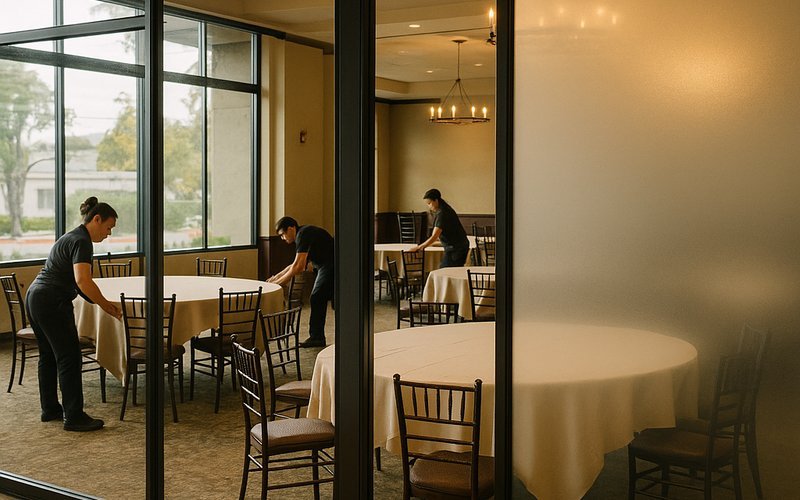
Yes. Smart glass partitions can convert one open event space into two, three, or more private rooms in seconds, without any physical reconfiguration, by switching individual panels from clear to opaque independently. This is one of the fastest-growing use cases among Los Angeles event venues booking corporate functions, weddings, and private parties in the same space on different nights.
The mechanics are straightforward. Each glass panel or film section is wired to its own control zone, so a venue manager can keep panel one clear while switching panels two and three opaque, creating a private room out of half the floor while the rest stays open. Multi-zone control panels or app-based control let staff reconfigure the space between bookings without touching a wall.
Event venue operators in Los Angeles who host back-to-back bookings on the same day find this especially useful. A daytime corporate meeting might need one enclosed room and an open lounge area. That same evening, a private event might need the entire floor divided into three sections for different activities. Fixed walls can’t do that in the 90 minutes between bookings. Switchable glass can, since the reconfiguration is a control panel setting, not a construction job.
This flexibility also affects a venue’s bookable capacity. A space that can only be sold as “open floor” or “fully divided” limits what kinds of events it can host. A space with switchable glass zoning can be sold both ways, sometimes on the same day, which directly affects revenue per square foot.
Does Smart Glass Actually Work for Privacy and Ambiance in a Commercial Setting?
Yes, but the type of privacy depends on the product. PDLC smart glass provides full visual privacy when switched opaque, blocking sightlines completely, while smart film provides a similar effect at a lower cost point but with slightly less uniform opacity across very large panels. Both hold up well in commercial hospitality settings when specified and installed correctly.
Honestly, most installers will tell you the biggest mistake operators make is assuming all switchable products perform identically. They don’t. Higher-grade PDLC glass gives a cleaner, more uniform frosted appearance and tends to last longer under constant switching cycles, which matters in a restaurant flipping partitions on and off dozens of times a night. Film retrofits are a smart budget option for lower-traffic areas but show wear faster under heavy daily cycling.
Ambiance is where smart glass earns its keep beyond privacy. Because the glass can hold intermediate frosted states in some product lines, operators aren’t locked into a binary clear-or-opaque choice. A dining room can use a soft frost setting during regular service and go fully opaque only for private buyouts. Adding LED film to the glass layer lets venues program color washes or subtle lighting effects for events, turning a functional partition into a design feature guests notice and photograph.
Sound is a separate question from visual privacy, and it’s worth being direct about it: standard smart glass does not meaningfully block sound on its own. Acoustic performance depends on the glass thickness, air gap, and whether the installation includes a laminated acoustic interlayer, not the switchable layer itself. If sound privacy matters for a private dining room near a bar or kitchen, that needs to be specified separately from the switching function.
What Permits Do Los Angeles Restaurants and Venues Need for Smart Glass Installation?
In Los Angeles, most smart glass partition installations that don’t alter existing wall framing or occupancy load qualify as a minor alteration and can often move through the Los Angeles Department of Building and Safety (LADBS) with a standard plan check rather than a full building permit review. Projects that involve electrical work for switching controls or LED film integration require an electrical permit regardless of the glass scope.
| Project Type | Permit Likely Required | Reviewing Agency |
|---|---|---|
| Film retrofit on existing glass, no wiring changes | Often none, verify with LADBS | LADBS |
| Full smart glass panel replacing existing glazing | Building permit (minor alteration) | LADBS |
| New switching control wiring or app-based control system | Electrical permit | LADBS Electrical Division |
| Partition affecting egress path or occupancy count | Building permit + plan check | LADBS |
| Hotel bathroom wall replacement | Building permit if wall structure changes | LADBS |
The biggest permit trigger operators overlook is egress. If a smart glass partition is placed anywhere near a required exit path, LADBS will want to confirm the opaque setting doesn’t obscure exit signage or block a clear path of travel. This is a common point of confusion for restaurant owners assuming glass partitions are automatically exempt from occupancy rules simply because they’re not permanent walls.
Fire and life-safety review also comes into play for larger venues. Event spaces with occupancy loads requiring fire marshal sign-off should loop in the Los Angeles Fire Department early if the glass partitions affect room configuration options during an event. Most reputable installers will flag this during the site walk rather than leaving it for the operator to discover during final inspection.
Can Smart Glass Help Los Angeles Hospitality Venues Save on Energy Costs?
Yes, smart glass with tinting or electrochromic properties reduces solar heat gain through west- and south-facing glazing, which lowers HVAC load in Los Angeles venues with large window walls or glass storefronts. This matters most for restaurants and event spaces with floor-to-ceiling glass exposed to direct afternoon sun.
Los Angeles’s climate means many restaurants and venues run cooling systems hard for a large part of the year, especially spaces with west-facing patios or glass storefronts that catch late-afternoon sun. Electrochromic and PDLC smart glass can be tuned to reduce solar transmittance when switched, cutting the heat load hitting the HVAC system during peak sun hours without needing blinds, shades, or awnings that block the view entirely.
Beyond HVAC savings, smart glass also reduces the need for separate window treatments, which cuts ongoing maintenance and replacement costs over time. Blinds and curtains in commercial food service settings wear out fast, especially near kitchens and bars, and need regular replacement. Switchable glass has no moving fabric parts to clean, stain, or replace, which lowers the total cost of ownership even when the upfront installation cost is higher than blinds.
Some Los Angeles venue owners also pair smart glass upgrades with broader building envelope improvements when applying for utility-run efficiency incentive programs. Eligibility and rebate amounts depend on the specific program and glass specification, so it’s worth confirming current incentive terms directly with your utility provider before assuming a project qualifies.
How Do You Choose the Right Smart Glass Installer for a Los Angeles Hospitality Project?
The right installer for smart glass restaurant hospitality projects in Los Angeles has direct commercial hospitality experience, not just residential privacy glass work, and can show you completed restaurant, hotel, or event venue installations, not renderings. Ask specifically about switching cycle warranties, since commercial venues cycle glass far more often than a residential bathroom or bedroom application.
Hospitality installations have different demands than a home project. Panels get switched dozens of times a day, staff need simple controls that don’t require an IT background, and downtime during installation directly costs the venue money in lost table turns or event bookings. An installer who mainly does residential jobs may not have accounted for any of that in their bid.
Before hiring, ask these questions directly:
- How many restaurant, hotel, or event venue installations have you completed in Los Angeles specifically?
- What’s the switching cycle warranty on the glass, not just the manufacturer’s general warranty?
- Can installation happen after hours or in phases to avoid closing the venue during peak days?
- Do you handle the LADBS permit process directly, or is that on us?
- What happens if a panel fails, how fast can it be serviced without replacing the whole wall?
Pacific Smart Glass has handled hospitality installations across Los Angeles, including restaurant partitions, hotel bathroom conversions, and multi-zone event space partitioning, with crews who understand commercial permitting through LADBS and the switching-cycle demands specific to food service and event environments. You can see the full range of local project types on the smart glass service page for the area before requesting a quote.
If you’re weighing smart glass against a full operable glass wall system for a larger venue reconfiguration, it’s worth comparing both approaches before finalizing your floor plan, since the right choice often depends on how often you’ll actually reconfigure the space versus how much daily privacy switching you need.
Ready to move forward? Get a free, no-pressure estimate from a Los Angeles smart glass installer who’s actually done restaurant and hotel work, not just residential jobs, so your quote reflects what a commercial hospitality installation really requires from start to finish.