
Every spa owner researching a smart glass spa wellness center San Jose privacy upgrade eventually asks the same question: how do you give clients real privacy without losing the open, airy feel clients pay a premium for? Switchable smart glass and smart film solve this for $3,800–$9,500 per room installed, turning clear glass opaque at the flip of a switch or a phone app. San Jose’s mix of boutique day spas, medical wellness suites, and Santana Row-adjacent studios has made this one of the fastest-growing upgrades in personal services build-outs across the city. This guide covers real costs, whether the privacy actually holds up, what San Jose’s permit office requires, and which neighborhoods are installing the most. Get a free estimate from a licensed San Jose smart glass installer before you commit to a layout.
How Much Does Smart Glass Cost for a San Jose Spa or Wellness Center?
Smart glass for a San Jose spa or wellness center privacy application costs $3,800–$9,500 per treatment room, with smart film retrofits running lower at $1,200–$3,400 per opening. Your total depends on panel count, whether you’re replacing existing glass or applying film, and if you want app or wall-switch control.
A typical treatment room partition in a San Jose studio runs 6–8 feet wide by 7–8 feet tall. That single opening, converted to switchable PDLC (polymer dispersed liquid crystal) glass, lands in the $4,200–$6,800 range including wiring and a low-voltage transformer. Multi-room build-outs, like a four-room wellness suite near Santana Row, often see per-room pricing drop as electricians run shared conduit runs, bringing the average down to roughly $3,900 per room at scale.
| Installation Type | Typical Cost Range | Install Time | Permit Required? |
|---|---|---|---|
| Smart film on existing glass (per opening) | $1,200–$3,400 | 1 day | No |
| New switchable smart glass panel (single room) | $4,200–$6,800 | 2–3 days | Yes, electrical |
| Multi-room wellness suite (4+ rooms) | $15,600–$28,000 total | 1–2 weeks | Yes, electrical |
| LED film accent partition (add-on) | $2,500–$5,000 | 1 day | No, if low-voltage plug-in |
Your biggest cost driver isn’t the glass itself, it’s whether you’re doing new construction or a retrofit. New build-outs let electricians run wiring inside open walls before drywall goes up, which is cheaper than fishing wire through finished walls in an existing studio. If you’d like an accurate quote for your specific rooms, a licensed installer can walk your space and give you real numbers instead of a range.
Does Smart Glass Actually Provide Real Privacy for Treatment Rooms?
Yes. Quality PDLC smart glass switches to a fully opaque, milky-white state that blocks visibility from both directions, giving treatment rooms the same privacy as a solid wall while keeping natural light. It does not, however, block sound, so it works best paired with sound-dampening measures in shared-wall studios.
Here’s the honest part most product pages skip: smart glass gives you visual privacy, not acoustic privacy. A client getting a facial or massage in a switchable-glass room can’t be seen from the hallway once the glass is switched opaque, but conversation and equipment noise can still travel through a thin partition. San Jose wellness centers that share walls with reception areas or adjacent treatment rooms often add acoustic panels or a sound-masking system alongside the glass.
Switching speed matters too. Quality PDLC glass transitions from clear to opaque in under a second, so a therapist can flip a wall switch the moment a client steps in, no waiting, no fumbling with blinds or curtains between sessions. Cheaper film products sometimes have a visible haze even in “clear” mode, which some spa owners actually prefer because it softens harsh visibility during transition moments between appointments.
For a deeper look at how different privacy glass technologies compare on light control, sound, and durability, our complete guide to types of privacy glass breaks down which option fits which use case.
How Are San Jose Spas Near Santana Row Using Switchable Glass?
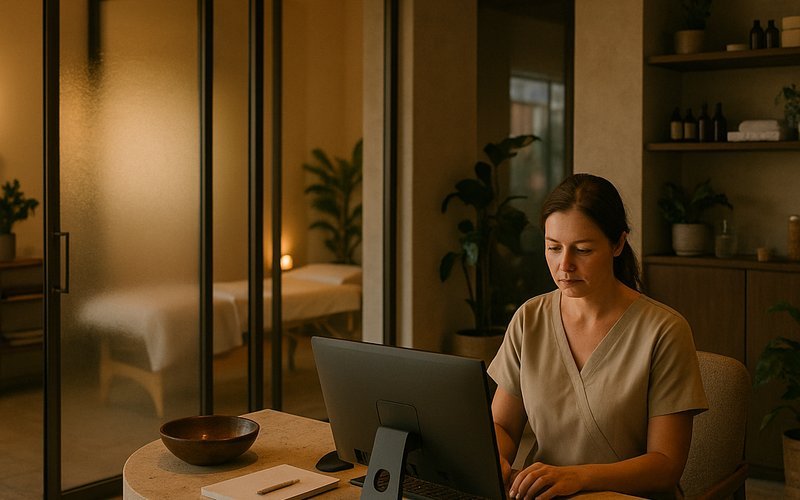
Spas and wellness studios near Santana Row are using switchable smart glass to convert single large treatment suites into two or three private rooms without permanent construction, and to give front-facing consultation rooms privacy during peak retail foot traffic hours.
Santana Row draws heavy walk-in and browsing traffic, which creates a specific problem for boutique wellness studios in that corridor: street-facing glass storefronts look great for marketing but leave clients feeling exposed during treatments. Several studios in that area have installed switchable glass on street-facing partitions, keeping the space bright and inviting when empty, then switching to full privacy the moment a session starts.
A wellness studio near Santana Row recently converted a single 320 sq ft open treatment area into two separate private rooms using a switchable glass divider wall, at a cost of roughly $7,200 including electrical work. The owner’s specific problem was booking capacity, not privacy alone. The switchable divider let them double room availability during peak hours without a full build-out or losing the option to open the space back up for group sessions on slower days.
Studios in this corridor also like that switchable glass doesn’t require the maintenance frosted film eventually needs. Adhesive-based frosting can peel or bubble at the edges within 2–4 years in a humid treatment room environment, while properly sealed PDLC units are rated for far longer service life.
Smart Film vs. Frosted Glass: Which Is Better for San Jose Treatment Room Partitions?
Smart film costs less upfront and switches privacy on and off electronically, while frosted glass is permanently opaque and cheaper long-term but offers no flexibility. For San Jose treatment rooms that need to flex between private sessions and open showroom hours, smart film wins on function even though frosted glass wins on raw price.
Frosted glass is a one-time purchase: you install it once and it’s permanently translucent, no wiring, no switch, no ongoing power draw. That works fine for a single-use treatment room that’s always meant to be private. But it fails the moment you want flexibility, like a room that doubles as a consultation space during the day and a private treatment room in the evening.
| Factor | Smart Film | Frosted Glass |
|---|---|---|
| Upfront cost (per opening) | $1,200–$3,400 | $600–$1,800 |
| Flexibility (clear/private on demand) | Yes | No, fixed |
| Install on existing glass | Yes | Requires glass replacement or etching |
| Typical lifespan in humid rooms | 7–10 years | 10–15 years |
| Requires electrical permit | Yes, if hardwired | No |
So which should you choose? If your treatment room needs to serve double duty, say a facial room that’s also used for retail consultations or product demos during off hours, smart film pays for itself in flexibility alone. If you’re building a dedicated massage or acupuncture room that will always be private, frosted glass is the cheaper, simpler call. Most San Jose wellness centers we work with end up choosing smart film for front-facing rooms and frosted glass for back-of-house rooms that never need to open up.
What Permits Does San Jose Require for Hardwired Smart Glass in a Wellness Business?
In San Jose, any hardwired smart glass installation that involves new electrical wiring requires an electrical permit through the City of San Jose’s Building Division, along with an inspection before the wall is closed up. Smart film applied to existing glass with no new wiring does not require a permit.
The distinction that trips up most spa owners is the difference between a plug-in low-voltage transformer and a hardwired, in-wall power run. If your installer is running new wiring inside the wall to power a switchable glass panel, that’s electrical work requiring a permit under San Jose’s building code, pulled through the City of San Jose’s Building Division at the Development Services Center. Skipping this isn’t just risky, it can hold up your certificate of occupancy or final inspection if you’re opening a new location.
Most licensed installers pull the permit for you as part of the project and coordinate the inspection, so you’re not standing in line at the counter yourself. Expect the permit and inspection process to add 1–2 weeks to your project timeline on top of install time, longer if your building falls under commercial tenant improvement rules rather than a straightforward personal services occupancy. If you’re leasing your space, check with your landlord too, since some commercial leases require landlord sign-off on any electrical modification, separate from the city permit itself.
Which San Jose Neighborhoods Are Seeing the Most Wellness Center Installs?
Willow Glen and the area around Santana Row are seeing the highest concentration of smart glass installs among San Jose spas and wellness centers, driven by dense boutique retail corridors and higher foot traffic that make privacy upgrades a priority.
Willow Glen’s walkable Lincoln Avenue corridor has a cluster of independent day spas and skincare studios in converted storefronts with large street-facing windows, the exact layout that benefits most from switchable privacy glass. Rossellini’s Row and Santana Row’s mixed retail-wellness tenants face similar exposure, with glass storefronts that need to stay inviting during open hours but go private the second a client walks in for a treatment.
Downtown San Jose’s growing wellness and medical spa scene is a newer driver too, particularly in mixed-use buildings where treatment rooms sit close to shared lobbies or coworking-style reception areas. Owners in these buildings often ask about the same partition products used in coworking spaces, since the privacy and light-control needs overlap closely. If that’s your situation, our guide on switchable glass partitions for San Jose shared office spaces covers similar hardware used in shared commercial buildings.
What Type of Privacy Glass Is Right for Your Space?
The right privacy glass for your space depends on three factors: how often the room needs to switch between open and private, your budget per opening, and whether you’re retrofitting existing glass or specifying new construction. There’s no single best answer, only the best fit for your specific room.
If you’re doing new construction or a full build-out, hardwired switchable smart glass is worth specifying from the start, since running wiring during framing is far cheaper than retrofitting later. If you’re leasing an existing space with glass already installed, smart film is almost always the more practical, less disruptive option, no demolition, no permit delay, and it installs around your existing schedule.
Honestly, most spa owners overthink the “which product” question and underthink the maintenance question. Ask your installer directly what warranty covers humidity-related failure, since treatment rooms with steam, hot towels, or essential oil diffusers run more humid than a typical office or retail space. A film or glass rated for standard interior use might not hold up the same way in a room that runs near 70% relative humidity for eight hours a day.
How to Find the Right Smart Glass Installer for Your San Jose Spa
Look for a San Jose installer with commercial experience specifically in personal services businesses, not just residential smart glass jobs, and confirm they pull their own electrical permits rather than leaving that to you.
Ask three things before you sign a contract: first, can they show you a completed spa or wellness center install in San Jose, not just renderings or out-of-state photos. Second, do they handle both the glass and the electrical permit application, or will you need to hire a separate electrician. Third, what’s their warranty on the PDLC film itself versus the installation labor, since these often carry different terms.
A good installer will also walk your specific rooms and flag humidity, ventilation, or wall-material issues before quoting a price, rather than giving you a number over the phone. That site visit is where a real quote gets built, not from a generic per-square-foot rate. When you’re ready to move forward, reach out for a walkthrough and quote from a team that’s installed switchable glass in wellness spaces across San Jose and knows exactly what the Building Division will ask for at inspection.