
When weighing smart glass vs window tint, Los Angeles homeowners sitting in a west-facing living room at 3 PM in August — blinds down, wondering why they even have windows — are asking exactly the right question. Window tint and smart glass both promise to fix this, but they solve the problem in very different ways at very different price points. Tint is always blocking, always visible from outside, and costs a fraction of smart glass. Smart film and smart glass switch between clear and opaque on demand, which matters enormously in dense neighborhoods like Silver Lake or Echo Park where street-facing privacy is real. Los Angeles sits in climate zones 9 and 10, where solar heat gain isn’t a minor inconvenience — it’s a design problem that drives cooling costs year-round. This guide covers costs, heat performance, HOA rules, permits, and the honest trade-offs so you can make the right call for your home.
What’s the Real Difference Between Smart Glass and Window Tint in Los Angeles?
In Los Angeles, the term “window tint” covers traditional dyed, metallic, ceramic, and nano-ceramic films that are permanently bonded to existing glass. They reduce solar heat gain constantly. Smart glass, by contrast, uses PDLC (polymer dispersed liquid crystal) technology to switch between opaque and clear states at the flip of a switch or a voice command. That’s the core distinction: one is always working, one is controllable.
Smart film is PDLC technology applied as a retrofit adhesive film to existing glass panes. It’s the middle-ground product. You’re not replacing your windows — you’re adding a layer that turns opaque when powered off and clears when powered on. Full smart glass panels are purpose-built, laminated IGUs (insulated glass units) with the PDLC layer embedded inside. These typically replace entire window or door assemblies.
There’s also a third option worth knowing about: LED film. It’s a transparent film with micro-LED technology that turns glass into a display surface. Mostly commercial, but it’s appearing in high-end LA homes as statement features.
Los Angeles climate zones 9 and 10 include most of the city’s inland and coastal areas. Solar heat gain is consequential here because summer temperatures regularly hit the 90s and 100s, and the sun angle means west-facing glass gets hit hard from roughly 1 PM through sunset. Which product you choose affects your SHGC (solar heat gain coefficient), your privacy options, and how your HOA reacts.
Smart Glass vs. Window Tint in Los Angeles: Side-by-Side Cost and Performance Comparison
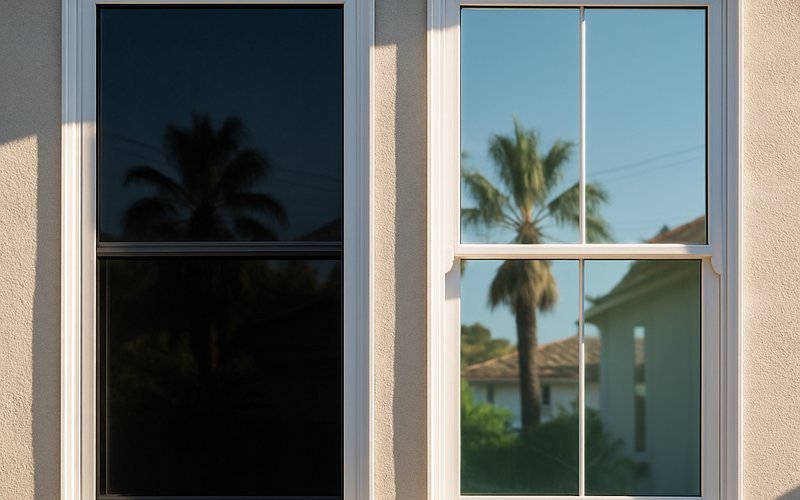
Before you hire anyone, get the numbers in front of you. Here’s how the four main options stack up on the factors that actually matter in Los Angeles:
| Option | Installed Cost (per sq ft, LA) | SHGC Performance | Privacy Control | Lifespan | Permit Required | HOA Impact |
|---|---|---|---|---|---|---|
| Traditional Window Tint | $8–$18 | SHGC 0.20–0.40 (good) | Fixed — always blocking | 7–15 years | No | Often restricted (dark/reflective) |
| Smart Film (PDLC retrofit) | $25–$85 | SHGC ~0.30–0.45 opaque | Switchable on demand | 10–15 years | Sometimes (if hardwired) | Usually approved — clear when off |
| Switchable Smart Glass Panels | $85–$180 | SHGC 0.15–0.35 (excellent) | Switchable on demand | 20–30 years | Yes (electrical + building) | Generally approved — architectural look |
| LED Film | $60–$120 | Minimal heat blocking | Partial (display use) | 8–12 years | Yes (electrical) | Varies — exterior display rules apply |
A homeowner in Silver Lake recently compared both options for a south-facing living room with roughly 180 sq ft of glass. Ceramic tint came in at $2,400–$3,200 installed. Smart film for the same area ran $4,500–$15,300 depending on the film grade. The tint solved the heat problem. But the privacy issue — a street-facing room with neighbors close by — wasn’t solved unless the tint was dark enough to prompt HOA review. Smart film won that specific project. That’s a real decision-making scenario you’ll face too.
Does Window Tint Actually Keep Los Angeles Homes Cool Enough?
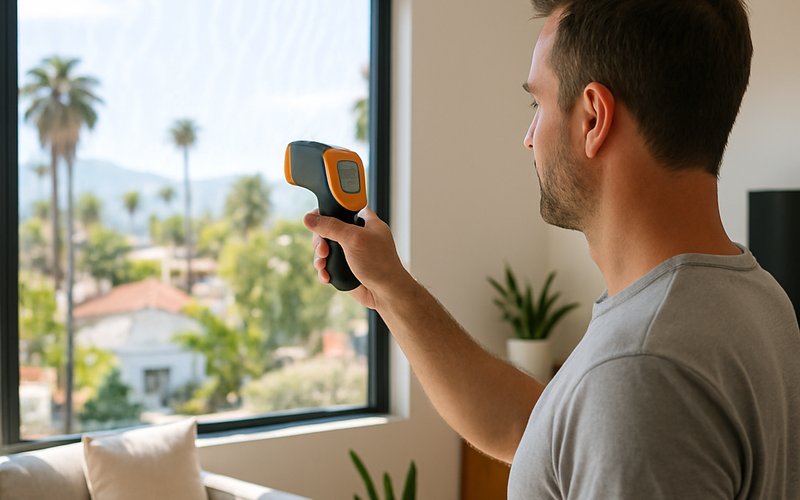
Quality ceramic window tint blocks 40–60% of solar heat, which is genuinely effective. In LA climate zone 10 — covering inland areas and much of the Valley — uncoated clear glass has an SHGC around 0.87. Ceramic tint brings that down to 0.25–0.35. That’s a real, measurable difference in cooling load.
West-facing rooms in Bel Air and Los Feliz see brutal afternoon heat loads from roughly 1 PM through sunset. Basic dyed tint fades faster in that sustained UV exposure and underperforms on heat rejection. Dyed films have SHGC values closer to 0.50–0.60 — better than nothing, but not enough for a glass-heavy room facing west in July.
Ceramic vs. Dyed Tint: The Gap Is Real
Premium ceramic or nano-ceramic tint outperforms dyed film by a wide margin — not just on SHGC, but on longevity, glare reduction, and the fact that it won’t turn purple after two LA summers. It’s worth paying the extra $3–$5 per sq ft for ceramic if heat is your primary problem.
Honestly, if pure heat blocking per dollar is your only goal, good ceramic tint is hard to beat. Smart glass in opaque mode blocks more solar heat than most tint products, but you’re paying 5–10x the cost for that upgrade. For a budget-conscious homeowner who doesn’t need on-demand privacy switching, ceramic tint delivers 80% of the thermal performance at 15–20% of the cost.
Smart glass wins the thermal performance debate on paper. In practice, it wins when privacy switching justifies the premium. For heat alone, tint is the smarter spend.
When Does Smart Glass Make More Sense Than Tint for Los Angeles Homeowners?
Smart glass earns its premium in specific situations. A bathroom needing both natural light and full privacy is the classic case — tint gives you privacy but permanently reduces light, frosted glass gives you privacy but never clears, and smart glass gives you both. That’s a problem tint can’t solve.
Glass-walled home offices are another scenario where smart glass wins clearly. You want transparency for the view, opacity for video calls or focused work. A switch or automation rule handles that. Tint just doesn’t offer that flexibility.
Dense Neighborhoods Where Privacy Really Matters
Street-facing bedrooms in Silver Lake and Echo Park are a genuine challenge. Homes sit close together on hillside lots, sightlines are tight, and you either live with blinds permanently closed or you invest in a real solution. Dark tint partially addresses this but you’re looking outside through a tinted filter 24 hours a day. Smart film solves it on demand.
Smart home integration is another factor. PDLC film and smart glass panels integrate with Lutron, Crestron, and standard smart home platforms. They can tie into sunrise/sunset schedules, occupancy sensors, or voice control. Tint doesn’t do any of that.
A homeowner in Bel Air recently used smart film on a glass-walled master bath for exactly this reason. The HOA had rejected every reflective and darkened tint proposal on aesthetic grounds. Smart film, which appears as clear glass when powered on, passed HOA review in one submission. The project covered roughly 120 sq ft at a total cost of $7,200–$9,800 installed. Problem solved, aesthetics preserved. That’s the scenario where smart film’s premium is fully justified.
What Do Los Angeles HOAs Say About Window Tint vs. Smart Glass?
In Los Angeles, HOA rules on window treatments are one of the most underestimated factors in this decision. Many HOAs in gated communities — particularly in Bel Air and Hancock Park — prohibit reflective or dark tint that’s visible from the exterior. They’re enforcing aesthetic consistency, and California Civil Code Section 714 limits how far they can go, but it still allows boards to enforce reasonable aesthetic rules.
Here’s the practical difference: standard window tint is visible from outside. Dark tint changes the look of the building facade. Reflective tint does too. HOA boards regularly reject both. Smart film and smart glass are typically clear when in their default “off” or “on” state, depending on configuration. They don’t change the exterior appearance of your windows in most operating modes. That’s why they regularly sail through HOA review where tint applications get rejected.
Silver Lake and Los Feliz both contain Historic Preservation Overlay Zones (HPOZs). In these zones, visible exterior changes — including window treatments — require additional review through the Los Angeles Department of City Planning. Smart film, which doesn’t alter the glass appearance, typically avoids this layer of scrutiny. Dark tint visible from the street may trigger it.
When hardwired smart glass or smart film is installed, it may trigger an electrical permit through the Los Angeles Department of Building and Safety (LADBS). That’s worth knowing before you sign a contract. Wireless or plug-in smart film installations are less likely to require permits. For a full breakdown of what requires a permit, the Los Angeles smart glass permit guide covers the current LADBS requirements clearly.
How Much Does Each Option Cost for a Typical Los Angeles Home?
Los Angeles labor rates run 15–25% above the national average, which affects every option here. Here’s how total project cost scales by window area across the three main options:
| Project Size | Window Tint (Ceramic) | Smart Film (PDLC) | Smart Glass (Full Replacement) |
|---|---|---|---|
| 200 sq ft (typical condo) | $1,600–$3,600 | $5,000–$17,000 | $17,000–$36,000 |
| 400 sq ft (mid-size home) | $3,200–$7,200 | $10,000–$34,000 | $34,000–$72,000 |
| 800 sq ft (larger home) | $6,400–$14,400 | $20,000–$68,000 | $68,000–$144,000 |
A 400 sq ft window project in Silver Lake runs roughly $3,200–$7,200 for professional ceramic tint, $10,000–$34,000 for smart film, and $34,000–$72,000 for full smart glass replacement. Those are real installed numbers, not contractor minimums. The gap is significant. For homeowners or landlords deciding between options, Pacific Smart Glass provides side-by-side quotes so you’re comparing real project costs, not per-sq-ft averages that don’t account for your specific window configuration.
Smart film is where most LA homeowners land when they want switchable privacy without full glass replacement. It hits the middle of this range and can be installed on most existing single-pane and double-pane windows without major structural work. If you’re wondering whether your specific windows are compatible, the best rooms for smart glass in LA homes guide walks through compatibility by room and window type.
Can Smart Film or Smart Glass Qualify for Southern California Edison Rebates in Los Angeles?
Smart glass that meets California Title 24 SHGC requirements may qualify under Southern California Edison energy efficiency programs. The key thresholds are a SHGC at or below 0.25 and a U-factor at or below 0.40 for most residential applications. Full smart glass IGUs with low-e coatings often meet these specs. Smart film retrofits on existing single-pane glass typically don’t — the base glass isn’t insulating enough to meet both thresholds together.
Traditional window tint generally doesn’t qualify for SCE rebates unless it’s part of a whole-window replacement that meets U-factor and SHGC requirements together. Tint alone, applied over existing glass, won’t change the U-factor. It improves SHGC, but that’s usually not enough for rebate eligibility on its own.
The California Energy Commission’s Title 24 compliance is the gateway to rebates here. LADBS enforces Title 24 on permitted work. If your smart glass installation is large enough to trigger a permit, your installer should be pulling a LADBS permit, and the glass specs will be reviewed for Title 24 compliance as part of that process — which then opens the door to SCE rebates.
Rebate programs change annually. Honestly, don’t count on a specific dollar figure until you get a written quote that includes the glass specs and a current SCE rebate application. Ask your installer to confirm Title 24 compliance on the product spec sheet before you commit.
What’s the Right Choice for Your Los Angeles Home? A Practical Verdict
In Los Angeles, the smart glass vs. window tint decision comes down to three questions. Answer them honestly and the right option becomes obvious.
- Is your budget under $10,000 for the project? If yes, ceramic window tint is your option. It handles heat well, lasts a decade or more, and doesn’t require permits. Smart film and smart glass are out of range at this budget for anything larger than a single bathroom.
- Do you need on-demand privacy switching? If yes, smart film is your minimum. Tint can’t do this. A glass-walled bathroom, a street-facing bedroom in a dense LA neighborhood, a home office — these are smart film scenarios. Budget $25–$85 per sq ft and plan for a licensed electrician if you’re hardwiring.
- Are you building new, doing a full remodel, or working on a high-end application in Bel Air? Then full smart glass panels are worth the investment. You get the best thermal performance, the cleanest installation, and a 20–30 year lifespan. For floor-to-ceiling glass walls, architectural features, or properties where resale value matters, smart glass pays for itself differently than it does in a standard residential retrofit.
Tint wins on upfront cost and pure heat rejection per dollar for anyone who doesn’t need switching. Smart film wins for renters, HOA-restricted properties, and anyone wanting switchable privacy without tearing out existing windows. Smart glass wins for new construction, remodels, and premium applications where the long-term value justifies the spend. To get an accurate quote for your specific windows and neighborhood in Los Angeles, reach out to the team at a trusted Los Angeles smart glass installer who can assess your glass, HOA rules, and Title 24 requirements in one conversation.