
Every retail block in downtown San Jose has that one storefront where the glass itself seems to glow with moving graphics, and nearby business owners want the same thing. LED film San Jose retail restaurant installations cost $18–$45 per square foot installed, with most single-window storefront projects landing between $2,400 and $6,800. San Jose’s sign ordinance treats illuminated window displays differently than exterior signage, which changes what you can install without a permit fight. This guide covers real cost ranges, the City of San Jose’s permit rules, and how LED film stacks up against neon and digital signage for local retailers and restaurants. Get a free estimate from a licensed Bay Area LED film installer before you commit to a design.
How Much Does LED Film Cost for a San Jose Storefront?
LED film for a San Jose storefront runs $18–$45 per square foot installed, with total project cost driven by resolution, transparency level, and whether you need a content management system for dynamic graphics. A typical downtown storefront window (roughly 8×10 feet) costs $2,400–$4,800, while a full-glass restaurant frontage with multiple panels can reach $8,000–$15,000.
Basic static-image LED film sits at the low end. Full-color, high-refresh video-capable film with a smart controller sits at the top. Labor for a single-window install usually adds $400–$900 on top of material costs, depending on glass height and whether scaffolding or lift equipment is needed for upper-floor windows.
| Project Type | Typical Size | Cost Range |
|---|---|---|
| Single storefront window | 8×10 ft | $2,400–$4,800 |
| Multi-panel retail frontage | 20-30 ft wide | $5,500–$9,500 |
| Full restaurant glass wall | 30-50 ft wide | $8,000–$15,000 |
| Content management upgrade | Any size | $800–$2,200 add-on |
A retailer in the Rose Garden neighborhood recently installed LED film across two adjacent storefront windows for $5,200, choosing a mid-tier resolution because the display faces a residential-adjacent street where brightness needed to stay moderate. That’s a good example of how location and neighborhood context change the spec, not just the square footage.
If you’d like an accurate quote for your specific storefront, reach out for a Bay Area LED film estimate and get exact numbers instead of a range.
What Is LED Film and How Does It Work on Retail Glass?
LED film is a thin, transparent polymer sheet embedded with micro-LEDs that adheres directly to glass, turning an ordinary storefront window into a digital display without blocking the view through it. Unlike a traditional screen or projector, the film stays transparent when the LEDs are off, so daytime foot traffic still sees into the store normally.
The film connects to a small control unit, usually mounted near the window frame or in a back room, that runs content through a media player or app-based dashboard. Most systems support scheduled playlists, so a restaurant can run lunch specials during the day and switch to ambient branding graphics after dark automatically.
Because it’s applied to existing glass rather than requiring a new window unit, installation is faster and cheaper than replacing storefront glazing. It also doesn’t require structural changes, which matters a lot when you’re leasing a space in an older downtown San Jose building where the landlord won’t approve glass replacement but will approve a film application.
Why Are SoFA District and Santana Row Retailers Using LED Film?
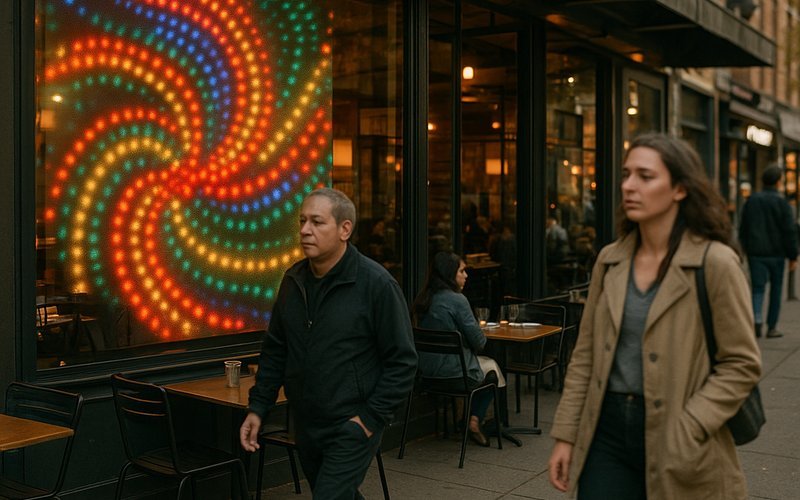
Retailers in the SoFA District and Santana Row are adopting LED film because it turns existing storefront glass into advertising space without the cost or permitting hassle of a new digital sign structure. Both areas see heavy evening foot traffic, and a glowing, animated storefront draws attention in a way static signage simply can’t compete with.
SoFA District bars and restaurants use LED film to run drink specials and event promotions that update in real time, which matters on a street where nightlife foot traffic shifts week to week. Santana Row retailers, working with higher-end storefront glass and stricter aesthetic standards from property management, use LED film because it disappears when off, preserving the upscale glass facade look during business hours while still allowing branded content after close.
Both districts share a practical constraint: glass replacement or new illuminated signage often requires landlord approval and City of San Jose sign review, while a film retrofit on existing glass frequently doesn’t. That’s a real cost and time advantage for a small business owner who wants results this quarter, not after a six-month permit process.
Does San Jose Require a Permit for LED Film Window Displays?
In most cases, applying LED film to existing storefront glass does not require a building permit from San Jose’s Building Division, because you’re not modifying the structure or the glazing itself. However, if the display is visible from a public street and functions as advertising, it falls under the City of San Jose’s sign ordinance, administered through the Planning, Building and Code Enforcement Department.
The key distinction is electrical work. If your installer needs to run new circuits or add a dedicated power source for the control unit, that portion of the job typically requires an electrical permit, even though the film itself doesn’t. Most installers wire into existing outlets near the storefront window, which avoids this step entirely.
San Jose’s sign ordinance also considers brightness, animation speed, and proximity to residential zones. A storefront on a mixed-use block near residential units may face brightness or motion restrictions that a purely commercial corridor wouldn’t. Before installing, it’s worth confirming with the City of San Jose’s Planning Division whether your specific block has overlay restrictions, especially if you’re planning full-motion video content rather than static rotating graphics.
LED Film vs. Neon and Digital Signs: What Fits San Jose’s Sign Ordinance?
LED film generally faces fewer permit hurdles than neon or LED digital sign boards under San Jose’s sign ordinance, because it’s classified as a window treatment on existing glass rather than a freestanding or wall-mounted sign structure. Neon signage and digital LED billboards typically require a sign permit and, in many cases, design review.
| Sign Type | Typical Permit Requirement | Typical Cost Range |
|---|---|---|
| LED film on existing glass | Usually none; electrical permit only if new wiring added | $2,400–$15,000 |
| Neon signage | Sign permit + electrical permit | $3,000–$12,000 |
| Digital LED sign board | Sign permit + design review + electrical permit | $6,000–$25,000+ |
Neon still has its fans, especially in older SoFA District bars going for a retro look, but it’s fragile, needs regular maintenance, and can’t display changing content. Digital sign boards can run full video, but they’re bulkier, brighter, and almost always trigger a full sign permit review, which can take 4–8 weeks in San Jose depending on the review queue.
LED film splits the difference: it can display dynamic, changing content like a digital sign board, but because it’s applied to existing window glass rather than mounted as a new structure, it often avoids the sign permit process entirely. That’s the single biggest reason retail and restaurant owners are switching over.
Which San Jose Neighborhoods Are Seeing the Most LED Film Demand for Retail and Restaurant Spaces?
Demand for LED film in San Jose retail and restaurant spaces is concentrated in the SoFA District, Santana Row, and Japantown, where storefront visibility directly drives walk-in business. Willow Glen is also seeing growing adoption among boutique retailers who want a modern edge without disrupting the neighborhood’s historic commercial character.
In Japantown, small restaurant owners are using LED film to run rotating menu highlights on narrow storefront windows where a traditional sign wouldn’t fit or wouldn’t be approved by the merchants association’s design guidelines. In Willow Glen, retailers along Lincoln Avenue have used LED film sparingly, keeping content muted and low-motion to stay in step with the neighborhood’s pedestrian-friendly, low-glare aesthetic.
A restaurant owner near Santana Row recently replaced a static vinyl window graphic with LED film showing a rotating happy-hour menu, reporting a noticeable uptick in walk-in traffic during the 4-6pm window specifically. That kind of targeted, time-based content is something static signage simply can’t do, and it’s the main reason demand keeps climbing across these corridors.
How Long Does LED Film Installation Take for a Restaurant or Retail Space?
Most LED film installations for a single storefront window take 1-2 days from start to finish, including surface prep, film application, and control unit setup. Larger multi-panel installs, like a full restaurant glass frontage, typically take 3-5 days.
Day one usually covers glass cleaning, measurement confirmation, and film cutting to exact window dimensions. Day two handles the actual application and wiring to the control system, plus testing content playback under different lighting conditions, since storefront glass behaves differently at noon versus after dark.
Restaurants often schedule installation during off-hours or a single closed day to avoid disrupting service, and most installers in the Bay Area accommodate early morning or overnight scheduling for exactly this reason. If your space has multiple window panels or unusually shaped glass, like the angled storefronts common in some SoFA District buildings, add an extra day for custom fitting.
How to Find the Right LED Film Installer in San Jose for Your Retail or Restaurant Space
The right LED film installer for a San Jose retail or restaurant space is one with direct commercial glazing experience, a track record on storefront-specific installs, and familiarity with San Jose’s sign ordinance so your display doesn’t get flagged after the fact. Not every window film company handles LED product, and not every LED sign company understands glass application.
Ask any installer you’re considering three things: how many storefront LED film jobs they’ve completed in San Jose specifically, whether they handle the content management setup or just the physical film, and whether they’ll confirm your project’s compliance with local sign rules before installation day. A installer who can’t answer the third question clearly is a risk, because you’re the one who’ll deal with a code enforcement notice, not them.
Pacific Smart Glass installs LED film for retail and restaurant storefronts across the Bay Area, including downtown San Jose commercial corridors, and handles both the physical application and the sign-ordinance groundwork before your install date. If you’re comparing LED film against smart glass or switchable film for a different part of your space, it’s worth reading how smart film performs on existing San Jose windows or checking whether your project needs sign-off under San Jose’s broader glass and glazing permit rules.
Honestly, most business owners underestimate how much the permit question matters until a code enforcement officer stops by. Get that answered before you sign a contract, not after. If you’re ready to move forward, get a free LED film estimate for your San Jose storefront and have your installer confirm sign-ordinance compliance as part of the quote, not as an afterthought.